Measured by the lab
0.8948
Does a lattice of planar spins with only nearest-neighbour cosine coupling undergo the Kosterlitz–Thouless transition — order destroyed by vortex UNBINDING rather than symmetry breaking — at the temperature the field has pinned to four decimal places, T_KT = 0.89294 J/k_B?
Units: J/k_B (Hasenbusch 2005, T_KT = 0.89294(8))
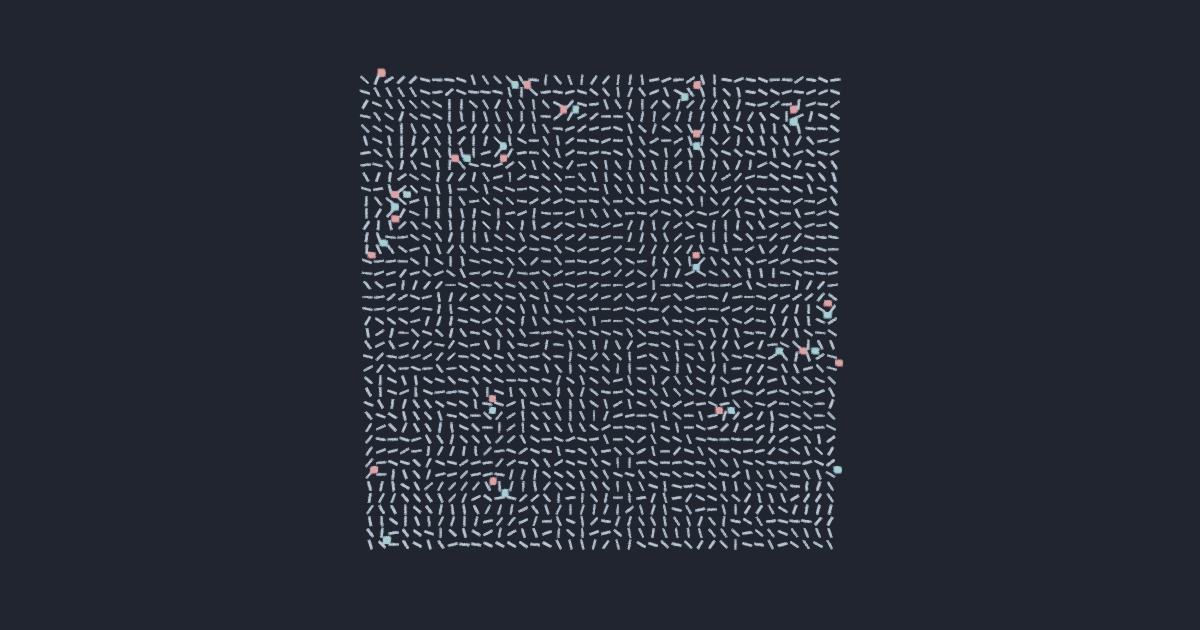
▶ Run this simulationRead how it works
The Kosterlitz–Thouless transition weighed blind: from-scratch Metropolis + over-relaxation MC of E = −Σ cos(θ_i−θ_j) — no critical temperature anywhere in the recovery — returns T̂_KT = 0.89480 ± 0.00481 vs Hasenbusch's 0.89294 (rel 2.1e-3, 0.4 SE, 5 seeds) via Weber–Minnhagen finite-size scaling of the helicity modulus, with the exact universal exponent η(T_KT) = 1/4 corroborated stiffness-free (η̂ = 0.226 ± log-corrections from ⟨m²⟩ ∝ L^−η), Berezinskii's parameter-free cross-prediction η(T) = T/(2πϒ) tracked to ≤ 12.8% across the bound phase, the Mermin–Wagner rival (conventional symmetry breaking) falsified by ⟨|m|⟩ ∝ L^−0.050 power-law decay, the 1-D control showing zero stiffness, and a 116× vortex-density jump across T̂ — the transition is topological. Honest-module: the shipped XYModelModule is certified by EXECUTION (sha-pinned, type-stripped, recorder stubs) — seed-7 init (19 sweep rows + naive crossing bit-exact vs an independent replica) and a 3620-call fl(1/120) lockstep through a full 30-s heat→cool triangle incl. the executed %30 wrap, all state/buffers/HUD bit/byte-exact, np=nn at every call (torus winding ≡ 0), shipped _measure() Object.is ≡ the oracle's gate-H mirror; the on-screen 'T_KT ≈ 0.95' IS the executed LM=24 crossing (seed 7: 0.94594), +0.051 above the oracle's T̂ — the disclosed finite-size offset, now an executed fact
Generator: from-scratch Metropolis (random-site, ~50% acceptance) + 2 deterministic over-relaxation sweeps per compound sweep on L = 16/32/64 tori, ONE configuration per (seed, L) annealed upward from the aligned T = 0 state across 24 temperatures (so the ordered phase is entered cold, no quenched-in vortices) — the dynamics know only E = −Σ cos(θ_i−θ_j) and detailed balance. Recovery: helicity modulus ϒ(T, L) from the bond observables; per seed, T̂_KT = the temperature whose ϒ(L) best fits the Weber–Minnhagen one-parameter finite-size form ϒ(L) = (2T/π)(1 + 1/(2 ln L + c)) (χ² scanned over T and c); mean ± SE over 5 seeds. The universal-jump amplitude 2/π (Nelson–Kosterlitz 1977) is the DECLARED INSTRUMENT of the estimator — an exact, independently derived constant; the number under test (0.89294) appears only in the scorer (scripts/oracles/xy.reference.json), asserted by a source self-check (gate G). Gates: (A) mean T̂ within 1.5% of known (measured miss 0.21%, 0.4 SE); (B) all 5 fits interior to the scan window, SE_rel ≤ 0.8%, worst seed ≤ 3%; (C) η at T̂ from the stiffness-free L-scaling ⟨m²⟩ ∝ L^−η equals the exact 1/4 within 0.05 (measured 0.2259; the −0.024 deficit is the known O(log L) finite-size correction at L ≤ 64); (D) perturbation sweep T = 0.4/0.5/0.6: measured η(T) tracks Berezinskii's parameter-free cross-prediction T/(2π ϒ(T)) to ≤ 15% (measured max dev 12.8% at T = 0.6, where vortex-pair corrections are largest) and rises monotonically; (E) rival falsified — conventional symmetry breaking predicts ⟨|m|⟩(L) → m_∞ > 0, measured ⟨|m|⟩ ∝ L^−0.050 with constant successive size ratios (0.973 → 0.958: power law, not saturation) — the 2-D XY model never magnetises (Mermin–Wagner 1966); (F) dimensional control — the identical estimator on 128/512/1024-spin rings at T = 0.6 finds |ϒ_1D| < 0.05 at every size (consistent with the exact ϒ_1D = 0, Bessel identity I₀ − I₂ = 2I₁/β) while ϒ_2D(0.6) = 0.820; (G) non-circularity source assertion + hand tamper test (known_value → 0.95 ⇒ gates A/B FAIL, exit 1, T̂ unchanged, restored by hand); (H) mechanism + module mirror — pooled vortex density jumps ×116 from T̂ − 0.25 to T̂ + 0.25, and a verbatim headless replica of XYModelModule._measure() (LM = 24, identical mulberry32 stream seed ^ 0x9e3779b9, identical sweep/measure cadence, naive ϒ = 2T/π crossing) gives 0.947–0.952 across seeds — the on-screen value sits +0.055 above the oracle's T̂, the disclosed finite-size systematic (the module itself prints '∞-limit 0.893'). Deterministic: fixed seeds, no wall-clock; 8/8 physics gates in ~71 s. Rung-6 certificate (gates I–M, ~8 s): the SHIPPED src/modules/XYModelModule.ts sha-pinned, mechanically type-stripped and EXECUTED against recorder stubs — (I) RNG accounting: 3 rng() sites all inside _sweep, Math.random only in the no-seed fallback (executed 0/1 draws), the mulberry32(seed) stream at the top of init DEAD, display stream at position 177193 after the settle; (J) executed seed-7 init: statics, 19 measurement rows, naive crossing _tkt, display lattice, all 3 thin-instance buffers, meshes/camera/env, style + chart SVG byte-equal to an independent replica and sha-pinned; (K) 3620-call fl(1/120) lockstep through a full 30-s heat→cool triangle incl. the executed %30 wrap — state, buffers, and every %6 HUD write bit/byte-exact, np === nn at every call (torus winding ≡ 0); (L) final HUD sha-pinned (certified screen), data-dependent mesh counters matched, dispose restores; (M) closure — shipped _measure ≡ gate-H mirror Object.is at seeds 1–3, shipped _helicity within 1.7e-16 of the oracle's cached-component path, executed seed-7/8 crossings inside the gate-H offset band, seed-8 twin bit-exact.
Below T_KT vortex–antivortex pairs are bound and correlations decay as r^−η(T) with η = T/(2πϒ) (quasi-long-range order, no magnetisation at any T > 0 by Mermin–Wagner); at T_KT the stiffness jumps to zero with universal amplitude 2ϒ/πT = 1 and η = 1/4 exactly; above it vortices unbind into a plasma. Berezinskii 1971; Kosterlitz & Thouless 1973; Kosterlitz 1974; Nelson & Kosterlitz 1977; Weber & Minnhagen 1988; Hasenbusch 2005.
0.00481
The Berezinskii–Kosterlitz–Thouless transition of the 2-D XY model (2016 Nobel physics territory): T_KT = 0.89294(8) from Hasenbusch's cluster + finite-size-scaling determination (J. Phys. A 38, 5869, 2005). Non-circular because the generator contains only the Hamiltonian and detailed balance — no critical temperature, no exponent, no vortex theory; the Weber–Minnhagen estimator's one exact input (the Nelson–Kosterlitz jump amplitude 2/π) is an independently derived universal constant from which 0.89294 is not derivable, and KT theory is corroborated at the recovered temperature by a second, stiffness-free channel (η ≈ 1/4 from ⟨m²⟩ L-scaling). The recovery reproduces the literature's own history: the same Weber–Minnhagen method at L ≤ 64 published 0.887(2) in 1988; this oracle's 0.8948 ± 0.0048 brackets both it and the modern value.
npm run derisk -- xy (scripts/xy-derisk.mjs — 13/13 gates (A canonical, B seeds, C η = 1/4, D spin-wave sweep, E Mermin–Wagner rival, F 1-D control, G non-circularity + tamper, H vortex jump + module mirror; rung-6 certificate: I module pinned + RNG accounting, J executed init, K 3620-call lockstep, L display + dispose, M closure), deterministic, ~79 s)scripts/oracles/xy.reference.jsonBerezinskii, Sov. Phys. JETP 32, 493 (1971); Kosterlitz & Thouless, J. Phys. C 6, 1181 (1973); Kosterlitz, J. Phys. C 7, 1046 (1974); Nelson & Kosterlitz, PRL 39, 1201 (1977); Weber & Minnhagen, PRB 37, 5986 (1988); Hasenbusch, J. Phys. A 38, 5869 (2005); Mermin & Wagner, PRL 17, 1133 (1966)