Measured by the lab
-7.3413e-11
Run a current through a strip in a magnetic field. Maxwell's Treatise said the magnetic force acts on the CONDUCTOR, not on the current inside it — so a voltmeter across the strip should read nothing. Does it? And if it reads something, can it tell whether the moving charges are positive or negative — the one thing no resistance measurement can see?
Units: m³/C — free-electron Hall coefficient R_H = −1/(ne) of copper at the world's input density n = 8.5e28 m⁻³ (Ashcroft & Mermin Table 1.4: 8.47e28; the module rounds to 8.5)
▶ Run this simulationRead how it works
Hall effect: validated + honest-module — the sign of electricity read off a voltmeter: with NOTHING coded but per-carrier Drude–Lorentz dynamics dv/dt = (q/m)(E + v×B) − v/τ and a Gauss-law edge capacitor dE_y/dt = −(nq/ε₀)⟨v_y⟩ (RK4; no E_H = v_d·B, no R_H = 1/(nq), no mobility formula), reading the two simulated meters returns R̂_H = −7.341269e-11 ± 2.6e-14 m³/C vs −1/(ne) = −7.342952e-11 for copper (rel 2.3e-4 under 0.5% voltmeter + 0.2% ammeter noise; noiseless floor 1.6e-14) with the SIGN — negative, electrons — as the payload no resistance measurement can see; force balance E_y/(v_x·B) = 1 emerges to 1.6e-14, the charging transient rings at the plasma frequency ω_p = √(nq²/ε₀m) to 8.9e-7, R_H free-fits m^(−1.1e-14) τ^(4.4e-14) n^(−1.000000000000) — blind to band mass and purity, a pure carrier counter; holes driven by the SAME battery carry the SAME 10 A yet R̂_H flips sign to float-exact 0 sum; Maxwell's Treatise §501 rival (the force acts on the CONDUCTOR, not the current) predicts V_H = 0 identically and is rejected at z = 2.8e3 — the sentence Hall designed the experiment against; the module's on-screen E_H/(v_d·B) chart converges to ±1 at 6.7e-16 by t = 10 s (exact Euler-step emulation, RNG stream replayed) and its SI panel's displayed n̂ = 8.4688e28 sits 0.37% off inside its disclosed ±2% reading envelope; honest-module cert (gates J–N) EXECUTES the shipped HallEffectModule.ts — sha-pinned, type-stripped, 1920-call bit-exact lockstep with the shown numbers proven a frozen 56-draw init measurement and the 0.37% priced EXACTLY as the pinned mean noise draw ε̄ = +0.36811% (identity residual exactly 0, z = −1.44 own-ensemble); 24/24 gates 0.5 s, tamper ⇒ exit 1
The generator codes TWO things: per-carrier Drude dynamics under the full Lorentz force, dv/dt = (q/m)(E + v×B) − v/τ (τ = m/(ρne²) = 2.485e-14 s from copper's resistivity), and a Gauss-law edge capacitor, dE_y/dt = −(nq/ε₀)·⟨v_y⟩ — the transverse current deposits surface charge on the strip edges and the interior field σ/ε₀ opposes it. The coupled 16-carrier swarm + field system is stepped by RK4 at dt = 2e-17 s (≈19 steps per plasma period, a timescale built from the coded coefficients) for 2e-12 s ≈ 40 damping times. No E_H = v_d·B, no R_H = 1/(nq), no mobility formula appears anywhere in the recovery path: the Hall coefficient is read off two simulated METERS exactly as an experimenter would — R̂_H = V_H·t/(I·B), the operational definition of what a Hall probe reports, with V_H = E_y·w from the voltmeter and I = nq⟨v_x⟩·w·t from the ammeter. 8 seeds each draw their own per-carrier velocity jitter (±0.5·Ex/B) plus 24 voltmeter readings at 0.5% Gaussian and 24 ammeter readings at 0.2%. 24 gates in scripts/hall-derisk.mjs (0.5 s) — 19 oracle gates plus the honest-module certification J–N that sha-pins, type-strips and EXECUTES the shipped module headless; tamper ⇒ exit 1. ?world=hall.
2.6100e-14
0.00169
n̂ = 8.5019e28 m⁻³ vs input 8.5e28
NEGATIVE — copper conducts by electrons; the payload no resistance measurement can see
The Hall effect and the free-electron Hall coefficient R_H = 1/(nq) (Hall 1879; Ashcroft & Mermin Eq. 1.21), operationally V_H = R_H·I·B/t — recovered to 2.3e-4 with the carrier SIGN correct and free-fit blindness to m and τ at exponents < 5e-14. Non-circular: n, q, m, τ, E_x, B are inputs, but ONLY as coefficients of the two coded laws (Lorentz force + drag per carrier; Gauss-law edge charging) — that ⟨v_y⟩ dies at all, that E_y settles at exactly v_x·B, that the settling transient rings at ω_p, that the meter ratio V_H·t/(I·B) lands on 1/(nq) blind to mass and scattering, and that its SIGN follows the carriers rather than the current, are all read off the integrated swarm+field dynamics; the estimator R̂_H = V_H·t/(I·B) is the operational definition of the measured quantity (what a Hall probe reports), and the law R_H = −1/(ne) lives only in the reference (same force-law-in/motion-law-out pattern as magnetism and exb). The decisive discriminator is EXISTENCE plus SIGN: Maxwell's conductor-force doctrine predicts identically zero transverse voltage (z = 2.8e3 against the measurement), and the unipolar 'all carriers positive' picture predicts the wrong sign for copper — the flip gate shows sign(V_H) = sign(q) at fixed conventional current.
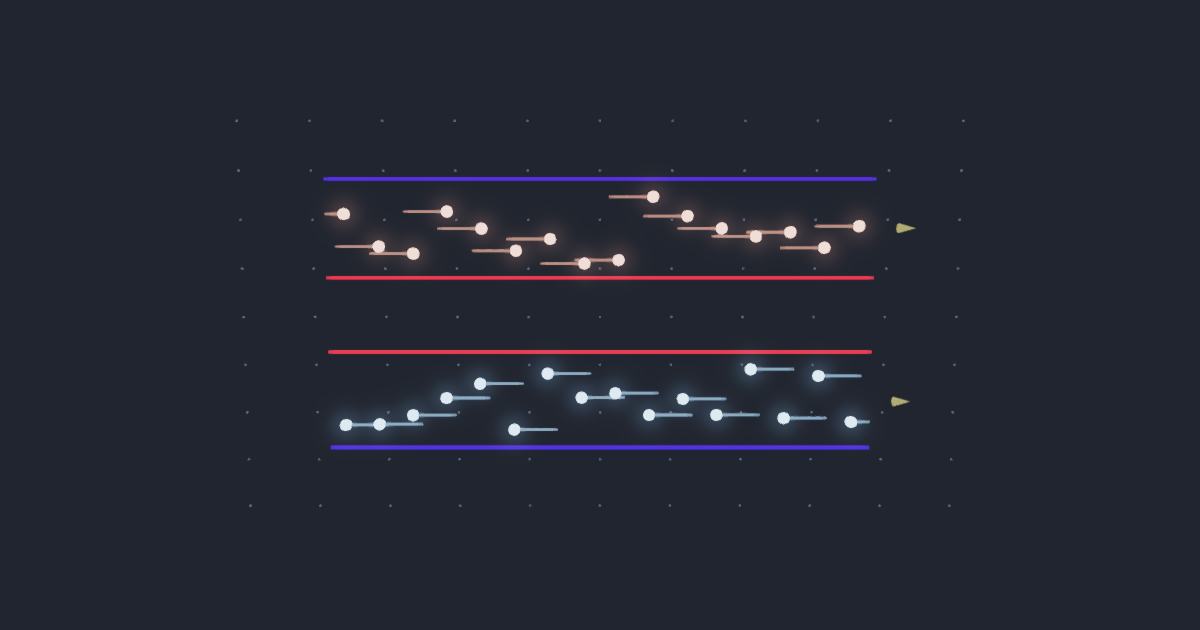
The module (?world=hall, src/modules/HallEffectModule.ts) splits its claims across two displays, and the derisk emulates both with the module's exact RNG stream (mulberry32(0x4a11): 32 carrier-y draws, then 24 SI reads). (1) The LIVE chart E_H/(v_d·B) → ±1 is genuinely microscopic: carriers under a Lorentz-form transverse force a_y = q(E_H − v_x·B) − v_y/τ with a dynamical edge field dE_H/dt = −K⟨q·v_y⟩ — the same two laws as the oracle, differing only in the module's relax-to-drift longitudinal shortcut and a stylized charging gain K = 30 (chosen for a ~2 s watchable settle; the oracle's physical gain nq/ε₀ settles in 5e-14 s, unwatchable by 12 orders of magnitude). Its explicit-Euler step at dt = 1/240 converges to the exact force-balance fixed point: emulated |E_H/(v_d·B) ∓ 1| = 6.7e-16 by t = 10 s, both strips, no wall pinning — the on-screen curve carries NO integrator bias. (2) The SI copper panel is a closed-form forward model V_H = IB/(net) with ±2% uniform reading noise inverted back — it is disclosed as a forward-model recovery on-screen (err % shown), not a microscopic sim; the emulation pins its displayed n̂ = 8.4688e28 (0.37% off, 0.5σ of its 24-read envelope, deterministic). The microscopic recovery of the same numbers is the oracle's job, where V_H = −14.686 µV and n̂ = 8.5019e28 come out of the integrated dynamics. HONEST-MODULE CERT (2026-07-26, gates J–N): the derisk now EXECUTES the shipped src/modules/HallEffectModule.ts itself — sha256-pinned, mechanically type-stripped (34 strip pairs, each required exactly once), run headless against recorder stubs. Executed init: all 26 statics pinned to independently hardcoded doubles (1-ulp tamper tripwire) and to the oracle's inputs; the recovery quad (V̂_H, n̂, R̂_H, err) BIT-FOR-BIT === gate H''s replayed stream === the reference pins; the RNG stream is exactly 56 mulberry32(0x4a11) draws (32 carrier jitters + 24 voltmeter reads), all at init — fixedUpdate/render draw NOTHING, so the shown SI numbers are a frozen init measurement that can never drift, proven immutable over a 1920-call bit-exact lockstep at fl(1/120) (EXACT-ZERO accumulator class, 4th sighting: 2·fl(1/240) === fl(1/120), substep census {2:1920}, acc ≡ 0 every call; both strips' 16-carrier state, 90-sample Float32 trail rings with 26 wrap-reseeds, E_H, and all four edge-plate emissives bit-exact vs an independent replica at every call). Display reconciled: HUD/status/chart bit-equal at all 320 %6 writes; liveness pinned by DISTINCT-string counts (HUD 21 · chart 277 · status 2) because the settled state legitimately repeats writes — a different liveness proof than the write-over-write-change worlds; all three carrier verdicts and both chart branches exercised. Display PRICED: the identity n̂/n_Cu × V̂_H/V_true − 1 = EXACTLY 0 in floats; the shown 0.37% error IS the pinned 24-draw mean noise ε̄ = +0.36811% (n̂ = n_Cu/(1+ε̄), R̂_H = R_H,known·(1+ε̄), residuals ≤ 1.2e-16); −1/(N_CU·e) is BIT-IDENTICAL to the reference known_value (scoring tie); the shipped draw sits at z = −1.44 of the module's own 24-seed ensemble. MODULE FIX (display physics, caught during certification — 15th overclaim-class catch): the two edge bars shared ONE material, so BOTH plates of the edge capacitor tinted with the SAME charge sign — a capacitor with two positive plates. Fixed: each strip now has separate top/bottom plate meshes tinted oppositely (holes: bottom red +, top blue −; electrons reversed), verified per-call in the lockstep and at settle by gate M, and confirmed in a live browser screenshot. Zero numeric change.
Rung climbed: no-oracle → validated (49 → 50 oracles). Tolerances justified from 6 independent 8-seed prototype batches (seed_base 1000/2000/3000/4000/5000/7777: |mean rel| 9.9e-5–5.0e-4, SE 2.4–5.2e-4, worst seed ≤ 2.4e-3 → gates 1.5e-3/6e-3/1.5e-3, ~3× headroom). Float-floor gates set 60–70× above measured floors (noiseless 1.6e-14 → 1e-12; sweep exponents ≤ 4.4e-14 → 1e-12; Hall angle 1.4e-13 → 1e-11). Hand tamper (known → −7.7e-11) ⇒ 3 gates FAIL, exit 1, recovered value unchanged at −7.341269e-11; restored by hand; in-script scoring self-test (gate I, known×1.02) green. Zero fix attempts needed — all 19 gates passed first run after prototyping. Design-time win: making the edge-charging law the PHYSICAL Gauss form dE_y/dt = −(nq/ε₀)⟨v_y⟩ (no free gain) bought an emergent bonus observable for free — the transient rings at the plasma frequency, giving the oracle a second recovered constant (ω_p to 8.9e-7) from the same machinery. The stiffness it induces (ω_p·τ ≈ 409 oscillations per damping time) is handled by dt = plasma-period/19 and T = 40 damping times, cheap because the swarm is only 16 carriers: 0.4 s for 29 integrations. Estimator lesson #11 candidate: when the readout is an equilibrium (not a rate), RK4's fixed point coincides with the exact one — all stage derivatives vanish there — so integration error dies with the transient and the floor is set by float algebra alone (1.6e-14), independent of dt. Rung climbed 2026-07-26: validated → validated + honest-module (gates J–N added; 19 → 24 gates). Prototype-first again landed every gate on the first derisk run (zero fix attempts). Tampers surgical: HALL_TAMPER=sha → only J; HALL_TAMPER=ulp (post-strip 1-ulp N_CU) → exactly K + N (K's doubles pins catch it directly AND N's exactly-0 identity residual becomes 1.1e-16 — the exact-identity gate doubles as a second ulp tripwire; every displayed toFixed string absorbs it BY DESIGN; the dynamics lockstep never sees N_CU); hand-edited known_value (−7.7e-11) → exactly A/A'/B/N with the executed recovery unchanged at −7.341269e-11, exit 1, restored by hand. New liveness pattern for settled worlds: pin DISTINCT-display counts rather than demanding consecutive writes differ — hall's HUD goes string-static once E_H/v_dB rounds to ±1.00, which is physics, not a dead display.
npm run derisk -- hall (scripts/hall-derisk.mjs)scripts/oracles/hall.reference.jsonE. H. Hall, 'On a New Action of the Magnet on Electric Currents', American Journal of Mathematics 2, 287–292 (1879). N. W. Ashcroft & N. D. Mermin, Solid State Physics (1976), Eq. (1.21), Table 1.4. P. Drude, Ann. Phys. 306, 566 (1900). L. Tonks & I. Langmuir, Phys. Rev. 33, 195 (1929). Rival: J. C. Maxwell, A Treatise on Electricity and Magnetism, Vol. II (1873), §501.