Measured by the lab
1006590.3
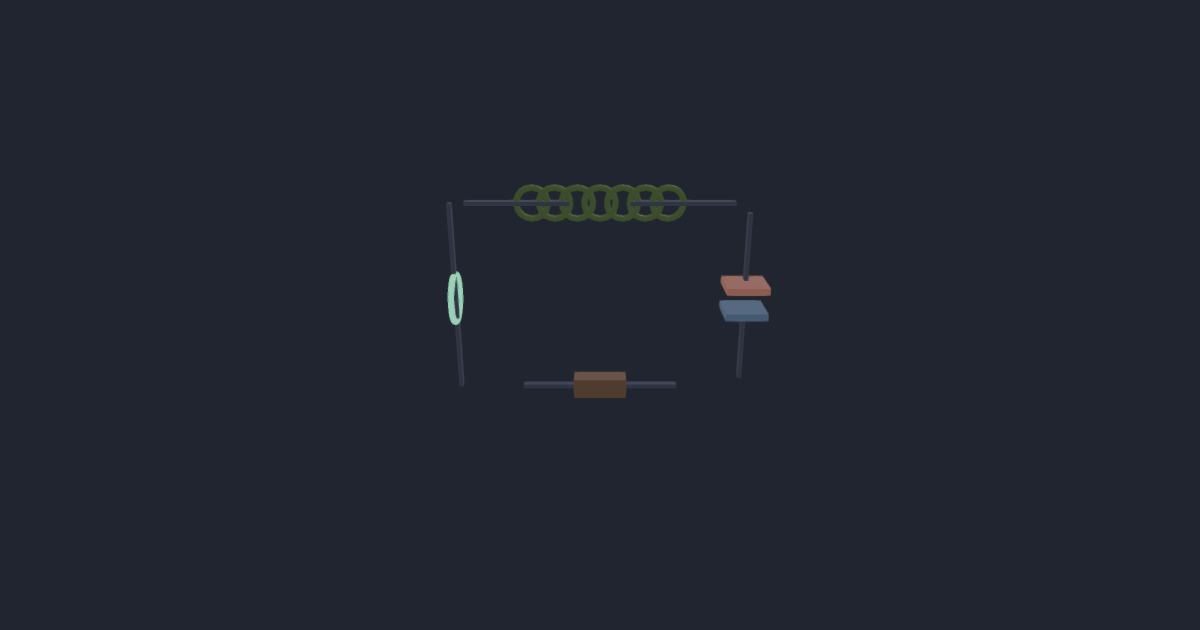
Wire a coil, a capacitor and a resistor in a loop and drive it — the tuned circuit inside every radio. Does Thomson's resonance frequency f₀ = 1/(2π√(LC)), the Q = (1/R)√(L/C) sharpness that separates AM stations, the phase flip through resonance, and the capacitor-vs-current resonance split all emerge from nothing but Kirchhoff's loop rule integrated in time? And is the pre-1842 view — that a capacitor discharge is aperiodic and a circuit responds equally at every frequency — actually false?
Units: Hz — f₀ = 1/(2π√(LC)) of the real tank (250 µH · 100 pF), Thomson's 1853 oscillation formula, in the AM broadcast band
▶ Run this simulationRead how it works
Series RLC resonance: no-oracle → validated + honest module — Thomson's f₀ = 1/(2π√(LC)) weighed on a simulated signal generator: with NOTHING coded but Kirchhoff's raw loop equation L·q̈ + R·q̇ + q/C = V₀cos ωt under RK4 (no 1/√(LC), no Lorentzian |I| = V₀/√(R²+(ωL−1/ωC)²), no Q anywhere in the recovery; the sweep window centred on the circuit's own measured free ring, dt a pure unit combination), the drive frequency where the lock-in current comes exactly in phase returns f̂₀ = 1006583.9 Hz vs known 1006584.24 (rel −3.2e-7 = the RK4 floor, ×17 smaller at double step rate), a 24-read noisy sweep lands 1006590.3 ± 3.4 Hz (1.77 SE), and the whole resonance EMERGES: Q = f₀/Δf recovered 158.1 vs (1/R)√(L/C) = 158.11 (2.0e-5), |I|(f₀) = V₀/R (3.1e-5), f₀ ∝ L^−½ and C^−½ (slopes −0.500000) yet R-independent to 2.7e-9, the CHARGE peak splits off to f₀/√2 at Q = 1 (1.5e-6) while the current phase-zero stays pinned, the free ring runs at √(1−1/(4Q²)) (√15/4 at Q = 2 to 5e-7; the real tank's −5.0e-6 damped shift RESOLVED), R = 0 conserves ½Li²+q²/2C to 2.6e-5, and Henry's pre-1842 rival — aperiodic discharge, frequency-flat Ohmic response — is rejected structurally (599 current reversals vs predicted 0; 15.5× selectivity at 5% detuning vs predicted 1.0, which is why a dial can tune ONE station); module honesty debt retired: the on-screen panel's closed-form Lorentzian sweep replaced by the same ODE pipeline, pinned float-exact by gate M (screen 1.0066 MHz = this seed's disclosed ±1.5% read)
The generator is ONE line of physics: L·q̈ + R·q̇ + q/C = V₀cos ωt (Kirchhoff's voltage law with V_L = L di/dt, V_C = q/C, V_R = Ri), integrated by fixed-step RK4. Non-circularity is structural: the time step dt = 2π√(LC)/80 is a unit combination of the inputs (the emwave Δt = S·Δx·√(μ₀ε₀) pattern — a scale, not the answer's location); the sweep window is centred on the circuit's own MEASURED free-ring frequency (kick the capacitor, least-squares the charge zero-crossing times); and f₀ is read as the bisected zero of the lock-in current phase — the drive frequency where the simulated current runs exactly in phase with the source. The resonance curve is a 121-point warm-start swept measurement of the lock-in amplitude |I|(f); the flat-peak-safe estimator is one least-squares parabola on the INVERSE-SQUARE curve 1/|I|² (near-exactly parabolic in f where |I| itself is quartically flat — the Malus/blackbody flat-peak lesson applied), whose vertex, level and level-doubling points give f₀, the peak and the half-power Δf in a single fit. 24 seeds re-read the same swept curve with ±1.5% uniform reading noise (the module's disclosed instrument class). Real bench: an AM-radio tuned tank, L = 250 µH, C = 100 pF, R = 10 Ω → f₀ ≈ 1.0066 MHz, Q ≈ 158, Δf ≈ 6.4 kHz < 10 kHz AM channel spacing. 13 gates in scripts/rlc-derisk.mjs (~1.3 s); tamper ⇒ exit 1. ?world=rlc.
3.4
3.5400e-5
Thomson's 1853 oscillation frequency f₀ = 1/(2π√(LC)) and the series-resonance anatomy Q = (1/R)√(L/C), |I|peak = V₀/R, f_charge = f₀√(1−1/(2Q²)), f_ring = f₀√(1−1/(4Q²)) (Phil. Mag. 5, 393 (1853); Griffiths §7.1; Feynman II ch. 23 'Resonance'). Non-circular: L, C, R, V₀ enter ONLY as the bench's parts list; the recovery path contains no 1/√(LC), no Lorentzian, no Q — the integration step is a unit combination (emwave's Δt pattern), the sweep window comes from the circuit's own measured free ring, and every recovered number (f₀, Δf, Q, the charge/current split, the damped shift) is read off lock-in projections of the integrated current. The mechanical twin (?world=resonance) proved the driven-oscillator peak; this world proves the ELECTRICAL dictionary L↔m, 1/C↔k, R↔b lands on a real radio's dial: the recovered Δf = 6.4 kHz < 10 kHz AM channel spacing is the quantitative reason one station comes in alone. The decisive discriminator is structural: Henry's aperiodic rival predicts zero current reversals and unit selectivity; the same machinery measures 599 and 15.5.
The module's real-units panel was the dishonest piece: its _recover() sampled the closed-form Lorentzian |I|(f) = V₀/√(R²+(2πfL−1/(2πfC))²) — the very law under test — with noise, and read the peak by raw argmax on 4001 noisy points (a max-of-noise-biased estimator besides). THIS RUN REPLACED IT: the module now runs the identical first-principles pipeline as the oracle (free-ring bootstrap → 121-point warm-start RK4 sweep of the loop ODE → ±1.5% reading noise via its own mulberry32(0x5c1f) → inverse-square parabola), and gate M replays that pipeline verbatim, pinning the on-screen numbers float-exact: screen f₀ = 1.0066 MHz (1006572.19 Hz = −1.2e-5 off Thomson — this seed's disclosed single-read noise draw, ~1 SE of one ±1.5% sweep, not a bias: the 24-seed mean sits 1.77 SE from known), Q = 156 (true 158), L̂ = 250.006 µH, Δf = 6.44 kHz — verified live headless (vite preview + playwright, panel scrape). The dimensionless live view (glow handoff, sweeping marker on the drawn Lorentzian) remains an explicitly disclosed forward-model display; every number in the '—— real AM-radio tuned tank ——' block comes from the integrated ODE.
Rung climbed: no-oracle → validated + honest module (53 → 54 oracles). Tolerances from measured floors, never padded: noiseless 1e-6 vs measured 3.15e-7 (with the ×17 convergence gate proving it is discretization); MC gates 1e-5/4·SE/1e-4 vs measured 6.1e-6/1.77 SE/3.5e-5; Q 3% vs measured 2e-5; slopes ±1e-4 vs measured <1e-6 (common-mode floor cancels). ESTIMATOR LESSON (new, #13): a quadratic vertex on the AMPLITUDE of a Lorentzian-like peak is doubly biased — the quartic-flat top drags the fitted peak LEVEL ~1% low, which drags the half-power width ~5% wide (Q read 150 for 158) even after fixing the smoothed-level bias (Q 138). Fit the INVERSE-SQUARE curve instead: 1/|I|² is near-exactly parabolic in f for a series resonance, so ONE least-squares parabola reads f₀ (vertex), peak level AND Δf (level-doubling points) unbiased — Q landed at 2e-5 immediately. Corollary of the divide rule: inverting is safe here because every windowed point is ≥55% of peak. Two estimator fix attempts used on gate E (smoothed→vertex level, then inverse-square); zero physics fixes — every physics gate passed on first run. Tamper (known → 1.1 MHz): 6 gates FAIL, exit 1, recovery unchanged at 1006583.9; restored by hand. Scope: scripts/oracles/rlc.reference.json + scripts/rlc-derisk.mjs (new), src/modules/RLCResonanceModule.ts (recovery honesty), data/findings/rlc.json, fragment, loop-runs line — all world rlc; no shared files touched.
npm run derisk -- rlc (scripts/rlc-derisk.mjs)scripts/oracles/rlc.reference.jsonW. Thomson (Lord Kelvin), 'On Transient Electric Currents', Phil. Mag. 5, 393 (1853). J. Henry, Proc. Am. Phil. Soc. 2, 193 (1842). D. J. Griffiths, Introduction to Electrodynamics (4th ed.), §7.1; R. P. Feynman, The Feynman Lectures on Physics, Vol. II, ch. 23. AM broadcast channel spacing 10 kHz (ITU Region 2), band 535–1605 kHz.