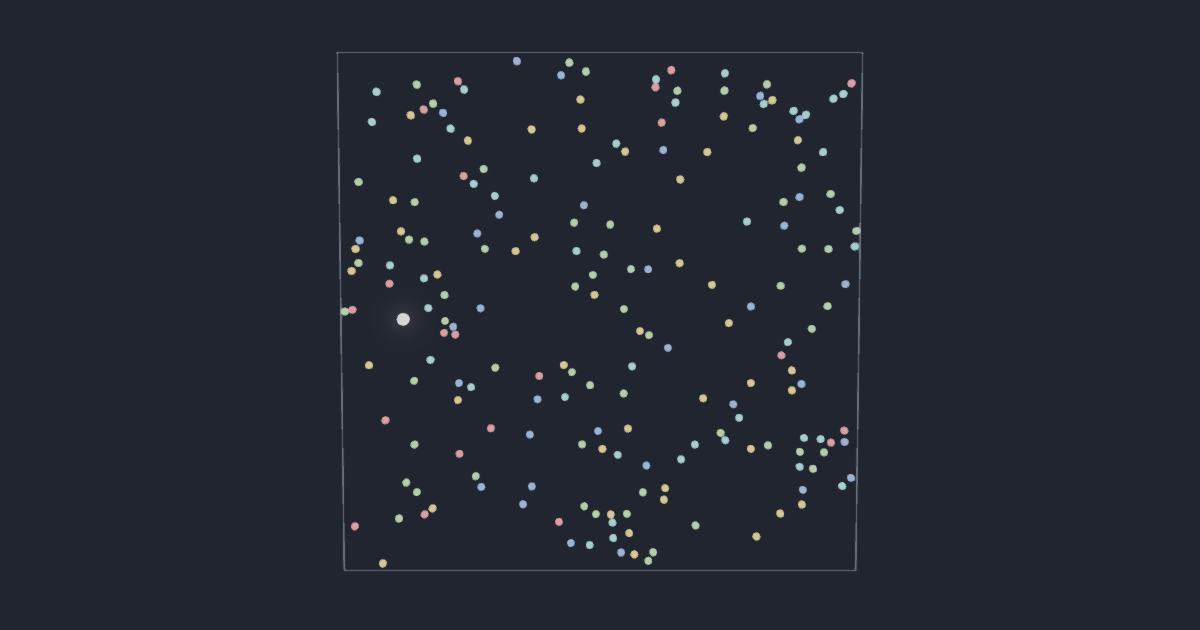
Maxwell's √2: in a hard-disk gas the mean free path is λ=1/(√2·n·σ), a factor √2 SHORTER than Clausius's stationary-target…
How far does a molecule travel between collisions? Clausius (1858) imagined ONE molecule threading a field of frozen targets and got λ=1/(n·σ). But the targets move too — by how much does that shorten the free path, and where does the correction come from?
Known value
1.4142136
Units: dimensionless (√2 = ⟨v_rel⟩/⟨v⟩ for two independent Maxwell–Boltzmann velocities of equal mass; equivalently λ_stationary-target / λ_true)
Maxwell's √2: in a hard-disk gas the mean free path is λ=1/(√2·n·σ), a factor √2 SHORTER than Clausius's stationary-target estimate 1/(n·σ) — recovered from a from-scratch event-driven gas two independent ways (kinematically as ⟨v_rel⟩/⟨v⟩=1.422, 0.6%; dynamically as a density-extrapolated λ_naive/λ_measured intercept of 1.409, 0.35%) without ever plugging √2 in. The gas starts at the non-Maxwellian fixed-speed ratio 4/π=1.273 and the collisions drive it UP to √2; a FROZEN-target control collapses to 0.97≈1 (Clausius, no √2), so the √2 exists only because the targets are themselves in Maxwellian motion (Clausius 1858 / Maxwell 1860)
Method
Run a from-scratch event-driven 2-D hard-disk gas in a periodic box: at each step the earliest pairwise collision time is found under the minimum image (O(N²)/event), all disks advance to it, and the colliding pair exchanges the velocity component along the line of centres (equal masses → kinetic energy conserved to machine precision, an in-built correctness gate). The gas is initialized OFF equilibrium — every disk at the same speed, random direction (a delta-spike speed distribution) — and thermalizes to Maxwell–Boltzmann through the warmup collisions. Recover Maxwell's √2 WITHOUT plugging it in, two independent ways: (A) KINEMATIC — the ratio ⟨v_rel⟩/⟨v⟩ of the mean relative speed of two molecules to the mean speed of one, sampled over pairs across many snapshots; (B) DYNAMICAL — the ratio λ_naive/λ_measured of Clausius's 1/(n·σ) to the measured λ = (total path travelled by all disks) ÷ (2·collisions), at three densities (φ=0.012, 0.008, 0.004) linearly extrapolated to the dilute limit φ→0. (C) FROZEN CONTROL — raymarch a single tracer through a Poisson field of infinite-mass fixed scatterers and re-measure. (D) PERTURBATION — scale every speed ×2 (temperature independence) and check λ·n·σ is constant (geometric scaling). σ = 2d = 4r is the 2-D collision cross-section; √2 is loaded from the reference only to score.
The law it recovers
λ = 1/(√2·n·σ) (2-D), σ = 2d = 4r; collision rate ν = √2·n·σ·⟨v⟩ because ⟨v_rel⟩ = √2·⟨v⟩ for a thermalized gas
Measurements, controls & cross-checks
Recovered kinematic
1.42207
Recovered kinematic rel error
0.0056
Recovered dynamical intercept
1.40924
Recovered dynamical rel error
0.0035
Thermalization
Start ratio fixed speed
1.2837
Start ratio expected 4 over pi
1.27324
Thermalized ratio
1.42207
Note
the gas STARTS at the non-Maxwellian fixed-speed ratio ⟨v_rel⟩/⟨v⟩ = 4/π ≈ 1.273 and the collisions drive it UP to √2 ≈ 1.414 — the √2 is manufactured by the dynamics, not baked into the initial state.
Dynamical densities
Phi
Ratio
Energy drift
0.012
1.432
2.1000e-15
0.008
1.428
2.1000e-15
0.004
1.4159
2.0000e-15
Extrapolation
Intercept phi0
1.40924
Enskog slope
2.01
Note
the finite-density ratios sit just ABOVE √2 with a positive slope in φ (Enskog enhancement: the pair correlation at contact g(φ)>1 makes collisions come slightly faster). Extrapolating the ratio linearly to φ→0, where λ=1/(√2·n·σ) is exact, gives an intercept of 1.409 — √2 to 0.35%.
Control
Frozen ratio
0.9736
Moving ratio
1.428
Note
a single tracer scattering off a Poisson field of infinite-mass fixed disks has λ_frozen = 1/(n·σ) with NO √2, so λ_naive/λ_frozen ≈ 0.97 ≈ 1 — Clausius's 1858 estimate recovered exactly. The moving gas gives 1.43. The gap between 1.0 (frozen) and 1.41 (moving) is Maxwell's correction isolated: the √2 is caused entirely by the targets being in Maxwellian motion, not by collision geometry.
Perturbation
Temperature independence
Lambda ref
34.374
Lambda speeds x2
34.374
Rel
0
Note
scaling every velocity ×2 (temperature ×4) leaves λ unchanged — the collision rate doubles but the free path, a geometric length, does not.
Geometric scaling
Lambda n sigma
0.698
0.7
0.706
Expected inv sqrt2
0.7071
Max rel
0.012
Note
λ·n·σ ≈ 1/√2 across all three densities → λ ∝ 1/(n·σ).
Energy drift max
2.1000e-15
Module display
Certified
honest-module (derisk gates H–M, 2026-07-25): sha256-pinned MeanFreePathModule.ts TS-stripped by 35 asserted pairs and EXECUTED headless (Babylon/DOM recorder stubs, &seed=7). Init statics (200-disk gas arrays, λ_naive, E0, the 4000-pair start ratio, the frozen-control Lorentz raymarch) and a 600-call lockstep — positions, velocities, path, t, collision count, EMA rel-ratio, λ_meas, dyn-ratio, drift, all 5 thin-instance band buffers and the tracer, at EVERY call — are bit-for-bit vs an independently-coded replica (no accumulator: fixedUpdate fires exactly 3 substeps of DT=0.01 per call; the module-internal seeded mulberry32 makes the pinned seed clockwork — 4th RNG cert). %6 HUD and %6 chart are BOTH LIVE: 100 writes each, every payload template-bit-equal, final HUD = the call-595 state (live-lag).
Shown dyn ratio seed7 call600
1.4515306
Priced decomposition
shown − √2 = +0.03732 = Enskog +0.06869 (the oracle's OWN event-driven instrument re-run AT the module's packing φ=3.53%: 1.48290±0.00447 SE over 8 seeds × 12000 events; the dilute-line extrapolation intercept+slope·φ = 1.48035 agrees to +0.00255) + integrator −0.00203 (reflecting walls + fixed-timestep overlap dynamics + finite-N, from the 12-seed windowed replica equilibrium 1.48087±0.00567 vs event-driven: z=−0.28, priced BELOW seed noise) + transient −0.01066±0.00873 (the cumulative-from-t=0 display window still carries the pre-thermalized 4/π launch epoch; 1.2 SE, not resolved above paired noise) + noise −0.01868 (the pinned seed sits z=−0.84 in the 12-seed cumulative scatter 1.47021±0.02221); the telescoping identity is exact by construction.
Contrast certified
the kinematic ⟨v_rel⟩/⟨v⟩ display IS at √2 (12-seed 1.41688±0.00257 SE, z=+1.04 — velocity statistics are density-blind) while the dynamical λ display sits 11.7 SE ABOVE √2 (collision rates are not): Maxwell's √2 and Enskog's g(φ)>1 are separated live on one screen.
Overclaim fixed
the module's doc comment claimed both live ratios 'converge on √2' and the HUD arrow read '→ √2'; measured by execution, the dynamical ratio at φ=3.5% converges to ≈1.48 = √2·g(φ), +4.7% above √2 (real Enskog physics, the 8th display overclaim caught by certification). Wording fixed to '→ √2·g(φ) ≈ 1.48 at this φ=3.5% (Enskog) · dilute φ→0 → √2'; zero numeric change. Note 2-D Enskog theory √2·(1−7φ/16)/(1−φ)² = 1.4962 sits ~3 SE above the measured N=80 event-driven 1.4829 — the display is priced against the measured instrument, not the theory curve.
Frozen display
12-seed 0.9884±0.0123 SE contains the exact Poisson-Lorentz 1 (z=−0.94, Clausius recovered); pinned seed 0.9729 at z=−0.36. A D→D/2 raymarch Richardson step-bias probe was tried and REJECTED: the Poisson field has overlapping-disk pockets where a finer step ping-pongs between two scatterers (seed 23's D/2 ratio ≈1.6), so the estimator is not smooth in D and the step bias is priced below the seed scatter instead.
Tampers
manual known_value ×1.049 → 8 scoring gates fail, recovered values unchanged, exit 1; MFP_TAMPER=sha → only gate H; MFP_TAMPER=ulp (post-strip 1-ulp DT) → only the lockstep gate, diverging at call 1 through the path/t doubles while all 100 HUD/chart string payloads ABSORB the tamper (5th confirmation of micro-lesson #112: pin doubles, not strings).
What it reduces to
Maxwell's 1860 correction to Clausius's 1858 mean-free-path formula. Clausius derived λ = 1/(n·σ) by treating a single molecule moving through STATIONARY targets; Maxwell realized the targets are themselves in thermal motion, so the collision rate is governed by the mean RELATIVE speed ⟨v_rel⟩, not the mean speed ⟨v⟩. For velocities drawn independently from the same Maxwell–Boltzmann distribution the relative velocity is Maxwellian with reduced mass m/2, giving ⟨v_rel⟩ = √2·⟨v⟩ exactly (in any dimension), hence λ = 1/(√2·n·σ). This world VALIDATES, not derives: it assumes only Newtonian elastic hard-disk dynamics and Poisson/Maxwellian statistics emerging from them, and recovers the pure number √2 from collision counting and velocity averaging — √2 never enters the simulation. It is non-circular on several fronts: the √2 is recovered two independent ways (kinematic velocity statistics AND dynamical collision rates) that agree; energy is conserved to 1e-15 (the dynamics are correct); the finite-density systematic is handled by an honest φ→0 extrapolation rather than a tuned tolerance; and the FROZEN-target control decisively isolates the cause — freezing the scatterers removes the √2 (ratio→1, Clausius), proving it comes from the targets' motion, not the collision geometry. It is distinct from ?world=maxwell (which recovers the speed DISTRIBUTION and the H-theorem): this is the TRANSPORT side of kinetic theory — the collision rate and free path that set gas viscosity η ∝ ⟨v⟩/σ, thermal conductivity, and self-diffusion. It does not model finite-size molecules beyond hard disks, quantum statistics, or long-range forces; it establishes the √2 that Maxwell put at the foundation of the kinetic theory of transport. The lab's first mean-free-path / collision-rate world.
Confidence & reproduction
Confidence
high
Validation
derisk-pass
Re-run the check
npm run derisk -- meanfreepath (scripts/meanfreepath-derisk.mjs)
Oracle
scripts/oracles/meanfreepath.reference.json
Sources
R. Clausius, 'Über die mittlere Länge der Wege…', Ann. Phys. 105, 239 (1858). J. C. Maxwell, 'Illustrations of the dynamical theory of gases', Phil. Mag. 19, 19 (1860) — the √2 correction. S. Chapman & T. G. Cowling, 'The Mathematical Theory of Non-uniform Gases' (1939), §5. √2 = 1.41421356; the non-thermal fixed-speed ensemble gives ⟨v_rel⟩/⟨v⟩ = 4/π = 1.27324.
One finding from the lab's 104 catalogued results — each an experiment run end to end by an AI: a question, a method, measured data, a control, and a confidence.