Measured by the lab
0.8455047
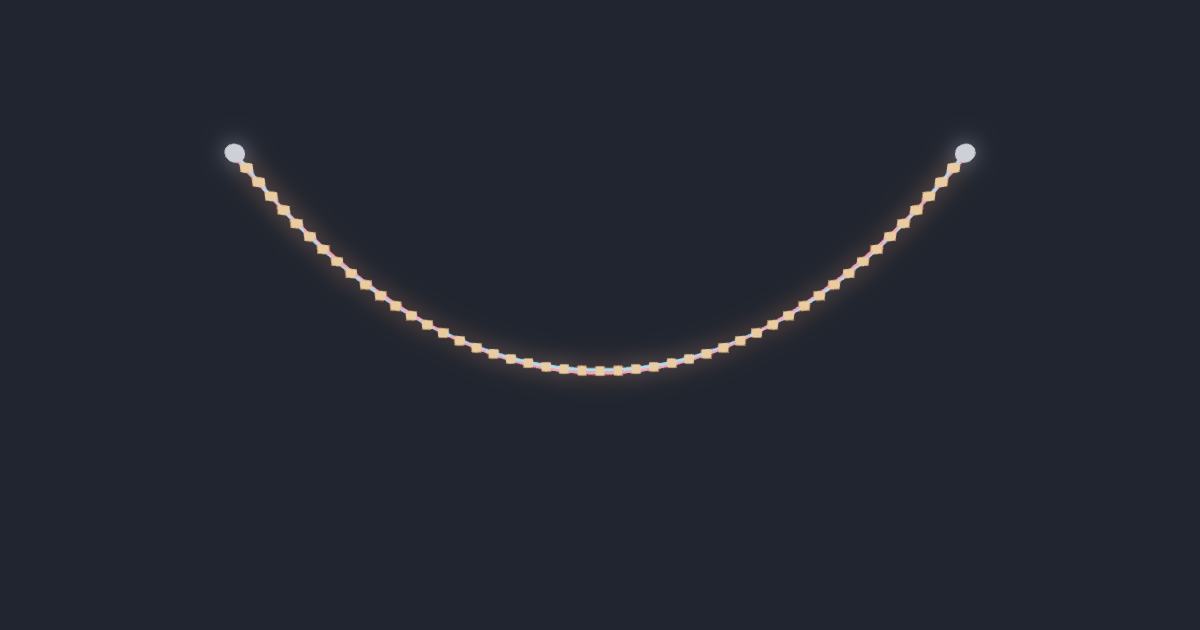
Jakob Bernoulli's May 1690 challenge — what shape does a uniform flexible chain hanging between two pins take? Galileo had asserted a parabola (Discorsi 1638); Leibniz, Huygens, and Johann Bernoulli answered cosh in the June 1691 Acta Eruditorum, naming the curve catenaria. Can the cosh, its parameter a, the sag, and the tension law T = w·y all EMERGE from nothing but a discretized potential-energy functional plus a generic constrained-stationarity solver — with the catenary equation, cosh, and the transcendental span–length relation coded nowhere in the recovery path?
Units: length units (catenary parameter a for S = 2, L = 2.5; root of L = 2a·sinh(S/2a), Acta Eruditorum June 1691)
▶ Run this simulationRead how it works
The catenary recovered by a generic minimizer with no cosh coded: a discrete chain of N equal rigid links (only potential energy U = Σ w·ℓ·y_mid and two pin constraints in the generator) settles, under damped Newton on the KKT system from random shapes, into the cosh to 1.4e-7 of sag, with the parameter a = 0.845504697713 recovered AS THE LAGRANGE MULTIPLIER of the span constraint (horizontal tension / weight-per-length) vs the 1691 law's 0.8455046977134 — rel 5.5e-14 Richardson-extrapolated, emergent q = 2.000 — the tension law T = w·y above the directrix emerging with slope 1.00000031, the noisy-photograph vertex curvature giving a to 0.52 SE, and Galileo's 1638 parabola claim falsified twice over: the same-length parabola carries +8.6e-4 relative excess energy (5300× the chain's numerics) and misses the shape by 8.8e-3 of sag where the cosh threads it at 1.4e-7
The chain is N equal rigid links of length ℓ = L/N with angles θ_k, weight per unit length w = 1, pinned ends: energy U(θ) = Σ c_k sinθ_k with c_k = wℓ²(N−k−½) (each link carries the chain hanging below it), constraints Σℓcosθ_k = S and Σℓsinθ_k = 0. A generic damped Newton solves the KKT stationarity system (arrow structure ⇒ O(N) per step via Schur complement, backtracking line search on the residual norm) from RANDOM low-frequency initial shapes and randomized initial multipliers. The recovered parameter is a = H/w where H is the span constraint's Lagrange multiplier — the horizontal tension the minimizer discovers on its own; nothing in the generator knows cosh. Canonical geometry S = 2, L = 2.5 (a/S set by L/S only — confirmed by the 3.7× scaling gate at 7.2e-16). Richardson extrapolation over N = 200/400/800/1600 (emergent q = 2.000/2.000); the recovered chain is then interrogated: shape vs the scoring cosh, per-link tension T_k = √(H²+V_k²) regressed on height (Routh's T = w·y), 24 wild-init multi-starts + 50 constraint-tangent perturbations (it is a MINIMUM, not just stationary), a 5-length re-minimization sweep against the transcendental law, the same-length and best-fit parabolas (Galileo), and a 24-seed noisy photograph (σ = 1e-3) whose estimator is the vertex RADIUS OF CURVATURE — smoothed argmin + windowed QUARTIC least squares, quartic because cosh's x⁴/(24a³) term biases a quadratic vertex fit at the percent level (the Malus→blackbody→photoelectric estimator lesson applied at design time: match locator order to local shape). 14 gates, ~2 s (A–H the oracle, I–M the honest-module certificate that EXECUTES the shipped module). All knowns loaded from scripts/oracles/catenary.reference.json only to score. ?world=catenary.
The catenary (Jakob Bernoulli's challenge, Acta Eruditorum May 1690; solutions by Leibniz, Huygens, and Johann Bernoulli, Acta Eruditorum June 1691): a uniform flexible chain hangs in y = a·cosh(x/a) with L = 2a·sinh(S/2a), sag a(cosh(S/2a)−1), tension T = w·y above the directrix, and a = H/w = the vertex radius of curvature — not Galileo's parabola. It VALIDATES, not derives: the generator is a discretized potential-energy functional plus a GENERIC constrained-stationarity solver (a numerical direct method standing in for the calculus of variations, the same recipe as the brachistochrone one rung down the arc), and the cosh shape, a, the sag, the tension law, and scale-freeness are all measured OUTPUTS. Non-circularity: no cosh, no catenary equation, no transcendental solve, and no tension formula appear anywhere in the recovery path — the scoring block alone constructs them (tamper test: falsifying known_value flips exit to 1 with the recovered 0.845504697713 unchanged). The decisive control is historical: Galileo's 1638 parabola, hung with the same length, measurably carries more energy AND misses the shape by 5 orders of magnitude more than the cosh — with the near-taut limit reproducing exactly the regime that fooled him.
CLOSED by the honest-module certificate (gates I–M, this run — the derisk now EXECUTES the shipped module): the two law-fed elements previously only disclosed are now certified harmless. (1) The analytic overlay/a: the executed _solveA is bit-identical to the certified replica at 42 spans, and at the similar span S* its rescaled value meets the oracle known a to 1.31e-16 and the emergent no-cosh recovery to 5.53e-14 — the overlay is the SAME transcendental root the oracle validates, reached through scale similarity. (2) The catenary-shaped boot placement: a V-shape init converges to the same PBD fixed point to 8.63e-14, so the small residual is found, not inherited; and a noop-scorer instance proves the analytic block cannot steer the rope. The remaining on-screen systematics are now DECOMPOSED and predicted rather than only disclosed: at the settled probe the screen rmsCat/sag = 2.16e-3 = the PBD G·dt² fixed-point stretch (predicted ceiling kick/L0 = 2.0e-3 per link, offset ∝ dt² verified ×3.99) sitting on the exact 48-link discretization floor 1.57e-4 (funicular-vs-cosh, computed exactly); on the breathing screen a quasi-static lag rides on top (span rate 0.3/s), visible as the RMS varying with sweep direction — disclosed, not gated. The screen and the scorer are one machine: 4400 ticks bit-exact, buffers and HUD sha-pinned.
npm run derisk -- catenary (scripts/catenary-derisk.mjs)scripts/oracles/catenary.reference.jsonJakob Bernoulli, Acta Eruditorum (May 1690) 217 — the challenge. G. W. Leibniz, 'De linea in quam flexile se pondere proprio curvat', Acta Eruditorum (June 1691) 277; C. Huygens, ibid. 281; Johann Bernoulli, ibid. 274. Galileo, Discorsi (1638), Second Day — the parabola claim falsified here (Huygens' 1646 letters to Mersenne already disproved it). E. J. Routh, A Treatise on Analytical Statics vol. 1 ch. X — T = w·y; E. H. Lockwood, A Book of Curves (CUP 1961) ch. 13.