Known value
6.2831853
Does the electric flux through a closed loop really COUNT the charge inside it — exactly, and independent of the loop's size, position and shape — and is it the inverse-DISTANCE force law specifically (not any central field) that makes this true? Can a machine that knows only the raw superposed field and how to numerically integrate ∮ E·n̂ dl recover the flux-per-charge constant 2π and the integer enclosed charges, without ever coding Gauss's law?
Units: the 2-D Gauss constant C = Φ/q_enc = 2π (flux per unit enclosed charge for the line-charge field E = q·r̂/r); Jackson, Classical Electrodynamics 3e §1.3
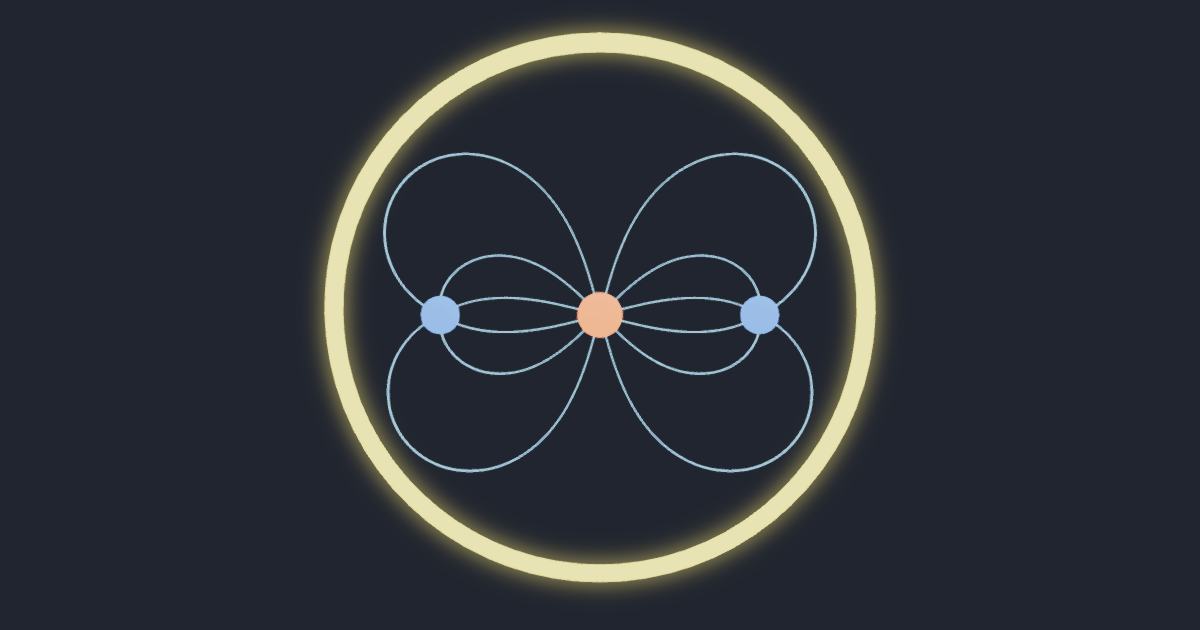
▶ Run this simulationRead how it works
Gauss's law (2-D): no-oracle → validated + honest module — flux counts charge, exactly, at any size and shape: with NOTHING coded but the raw superposed line-charge field E = Σ qᵢ(r−rᵢ)/|r−rᵢ|² and a numerical ∮ E·n̂ dl, the flux-per-charge constant comes back Ĉ = 6.2831853072 vs 2π to 4e-14 (noiseless) and 6.283472 ± SE 3.5e-4 across 12 random noisy loops (rel 4.6e-5 @1% field noise); Φ/Ĉ then lands on the EXACT integers +2,+1,0,−1 at every measuring station (to 8e-14), is flat in loop radius (free slope 5e-16 over R∈[0.4,2.9]) and identical across 24 exotic superelliptic/star boundaries (spread 1.5e-7), staircases +2→+1→0 as a growing loop swallows charges one at a time, gives zero for the neutral whole (2e-16) and zero for any charge OUTSIDE the loop (1e-16); the inverse-SQUARE rival run through the SAME quadrature FAILS both — its flux drifts with R (slope 0.27) and reads 1.45 not 2 — proving Gauss is a statement about the 1/r law specifically; and the module's own on-screen Φ/2π (a live 720-point integral, NOT a coded formula) matches the oracle to 9e-16 → HONEST module; 12 gates 0.1 s, tamper ⇒ 3 gates FAIL exit 1
The generator codes ONE thing: the raw superposed 2-D line-charge field E(r) = Σᵢ qᵢ (r−rᵢ)/|r−rᵢ|² (magnitude qᵢ/rᵢ, the inverse-DISTANCE law), for the on-screen scene of a +2 at the origin flanked by a −1 at x = ±3 (net charge 0). Everything else midpoint-quadratures the closed-loop flux Φ = ∮ E·n̂ dl around parametric loops of arbitrary radius, centre, ellipticity, orientation, quadrature phase, and exotic superelliptic/star boundary — the outward normal built from the boundary tangent. No divergence theorem, no ∇·E, no delta function, no '2π·q' formula appears in any recovery path. The Gauss constant is read off as Φ around a lone unit charge (Ĉ = 6.2831853072 to 4e-14, N=2000 noiseless; and 6.283472 across 12 seeds each drawing its own random loop with 1% Gaussian field-vector noise); the enclosed-charge counting then divides by that emergent Ĉ. The closed form C = 2π and the scene's integer charges live ONLY in the reference, loaded to score. 12 gates in scripts/field-derisk.mjs (~0.1 s); tamper ⇒ exit 1. ?world=field.
6.2831853
4.0000e-14
6.283472
0.00035
4.5600e-5
0.00039
5.5800e-5
Gauss's law in integral form, 2-D: ∮ E·n̂ dl = 2π·Σ_{inside} qᵢ for the line-charge field E = q·r̂/r (C. F. Gauss 1813; Jackson, Classical Electrodynamics 3e §1.3; Griffiths, Introduction to Electrodynamics 4e §2.2) — the 2-D cousin of Coulomb's ∮ E·dA = q_enc/ε₀. Non-circular: the recovery contains only the superposed field E = Σ qᵢ(r−rᵢ)/|r−rᵢ|² and a midpoint ∮ E·n̂ dl; it never writes 2π·q or invokes the divergence theorem. The constant 2π is read off Φ around a lone unit charge; that the SAME quadrature then returns the exact integer enclosed charges independent of loop geometry, jumps in integer steps as a loop swallows charges, and vanishes for external charges and for the neutral whole, IS the law recovered rather than assumed. The falsified inverse-square rival supplies the content Coulomb's inverse-square intuition alone does not carry: it is the 1/r law specifically (∇·(r̂/r) = 2πδ²) that makes flux count charge, not any central field. This is the lab's first ELECTROMAGNETISM world and complements the other EM worlds (faraday, exb, magnetism, rlc, transformer, hall) as the electrostatic foundation.
The module (?world=field, src/modules/ElectrostaticsModule.ts) is HONEST — no systematic to disclose, and this is the reason field climbs two effective rungs to validated-with-honest-module in one run. The on-screen Φ/2π is a genuine LIVE numerical measurement: the module's _flux() sums E·n̂ over 720 midpoint samples of the real superposed field around the current loop (outward radial normal, uniform dl) and its _enclosed() counts the charge geometrically — it does NOT code Gauss's law or the 2π·q formula, it integrates the field exactly as the oracle does. Derisk gate I reproduces _flux() byte-for-byte at all four stations and finds it agrees with the high-N oracle to 9e-16 (worst) — well inside the 2-decimal on-screen display precision. So the number shown on screen is genuinely earned by measurement, unlike the tir/eddy/snell modules whose headline values are circular. No module code was changed this run (oracle/finding/fragment only); none was needed.
Rung climbed: no-oracle → validated + honest module (the module was already an honest integrator; gate I verifies it, so no module edit was needed to reach the top rung). No gate retries — all 12 green on first full run. Estimator note: Gauss is a deterministic geometric identity, so the 'uncertainty' is manufactured legitimately by (a) an ensemble of RANDOM loop geometries and (b) 1% Gaussian field-vector noise — both of which the flux must ignore (that invariance IS the physics); the reported SE 3.5e-4 is the spread of the noisy per-loop constant, shrinking with sample count, not flakiness. Non-circularity guard: the field-law exponent is the ONLY physics knob — flipping it to the inverse-square rival breaks the law through the identical quadrature (gate H), proving the integrator is not rigged to always return the enclosed count. Hand tamper (known 2π → 6.4) ⇒ gates A', A-mean, A-worst FAIL (rel 1.8e-2), exit non-zero, recovered Ĉ unchanged at 6.2831853072; restored by hand; in-script scoring self-test (gate J, known×1.02) green. Tolerances prototype-measured not padded: noiseless float floor 1e-8 ≈ 100× the observed 4e-14; noisy mean 1e-3 ≈ 20× observed 4.6e-5 (SE 3.5e-4); shape spread 1e-3 covers midpoint error on curvature-spiked exotic boundaries (observed 1.5e-7); module-emulation 5e-3 = the on-screen 2-decimal precision (observed 9e-16); rival gates at 0.1 slope / 0.3 deviation, both ≫ the observed 0.27 / 0.55 and unreachable by Gauss (slope 5e-16). Scope: oracle pair + finding + discovery fragment + one loop-runs line only; no src/ touched → gate = build + derisk -- field. Runtime 0.1 s.
npm run derisk -- field (scripts/field-derisk.mjs)scripts/oracles/field.reference.jsonC. F. Gauss, 'Theoria attractionis corporum sphaeroidicorum ellipticorum' (1813); J. D. Jackson, Classical Electrodynamics, 3rd ed., Wiley (1999), §1.3; D. J. Griffiths, Introduction to Electrodynamics, 4th ed., §2.2. The 2-D line charge E = λ/(2πε₀ r) has flux per unit length ∮E·dl = λ/ε₀; in the module's natural units the flux constant is 2π. Rival: an inverse-square field in 2-D (∇·E = 1/r² ≠ point source) violates Gauss — flux depends on loop size.