Measured by the lab
2.267229
Does a 2-D lattice of spins with only nearest-neighbour alignment and thermal noise have a SHARP critical temperature — and does it sit exactly where Onsager's 1944 exact solution says it must?
Units: J/k_B — Onsager 1944, Tc = 2/ln(1+√2), exact closed form
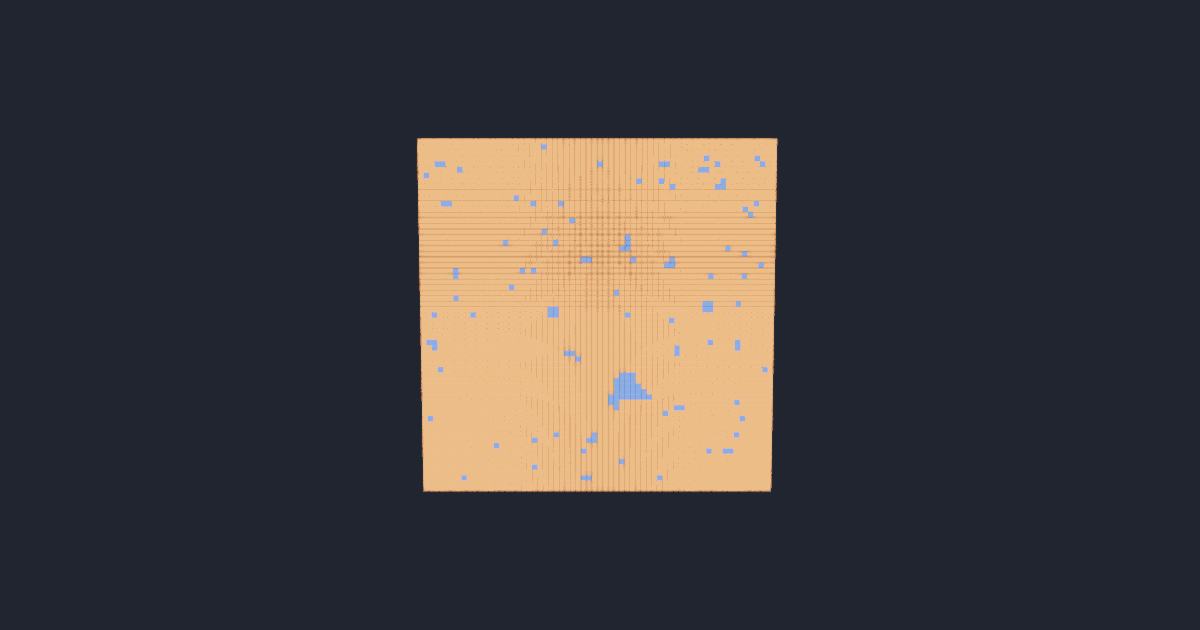
▶ Run this simulationRead how it works
The magnet melts at Onsager's number: a 2-D lattice of spins with only nearest-neighbour alignment loses its magnetisation at Tc = 2.26723 recovered vs 2/ln(1+√2) = 2.26919 known (rel 8.6e-4) — by Binder-cumulant crossings of from-scratch Wolff Monte-Carlo whose scan window is SELF-LOCATED (the recovery is never told Tc even to know where to look). The whole 2-D Ising universality class comes out with it, all measured, none fed: ν̂ = 0.991 (exact 1), γ/ν = 1.760 (exact 7/4, R² = 0.99999), β/ν = 0.120 (exact 1/8). The decisive pair: the SAME pipeline on the triangular lattice recovers the EXACTLY known Tc = 4/ln 3 to 1.4e-4 with the SAME exponents — critical temperatures are geometry, exponents are the universality class. Below Tc the measured ⟨|m|⟩ matches Yang's exact closed form to ≤ 9e-4; a 1-D chain at the very same temperature is pure disorder (⟨|m|⟩ ~ N^(−1/2)) — dimension, not the interaction, makes the phase transition. RUNG-6 HONEST MODULE: the shipped IsingModule is sha-pinned and EXECUTED headlessly — seed-7 init + a 7200-call fl(1/120) lockstep (60 s: the full 55-s temperature ramp including the executed ramp→hold clamp) bit/byte-exact against an independent hand replica in both spin lattices, both thin-instance buffers, all 1200 HUD writes and all 32 chart rebuilds; the on-screen 'measured Tc ≈ 2.314 vs 2.269' IS the executed L=48 χ′-peak, quantized to the 30-point grid (step 0.041), sitting +0.045 above Onsager inside the disclosed finite-size band — and twin seed 9 moves the underlying double a full grid step to 2.272, so every displayed digit of the measurement moves between certified seeds.
From-scratch Wolff cluster Monte-Carlo (the only algorithmic parameter, p_add = 1 − exp(−2J/T), contains no critical constant) on toroidal L×L lattices, L = 12…48. The recovery first SELF-LOCATES the transition — a coarse L = 24 susceptibility scan over T ∈ [1.6, 3.2] finds the χ′ peak (parabolic log refinement) and the fine 21-point window is placed around it, extending further down than up because the finite-size χ′ peak approaches the critical point from above (generic finite-size scaling; no Ising-specific constant). On the fine grid it measures ⟨|m|⟩, ⟨m²⟩, ⟨m⁴⟩ per (L, T) and reads Tc off the crossings of the Binder cumulant U = 1 − ⟨m⁴⟩/(3⟨m²⟩²), which is size-independent exactly at Tc (Binder 1981): the crossing is the locally-refit quadratic root of U_big − U_small (a straight-line root biases cold by ~4e-3 because the difference curve flattens on the cold side; the quadratic absorbs the curvature). Canonical estimate = the largest pair (24 vs 48) on moments pooled over 16 seeds × 800 measurement steps per point. Neither Tc nor ν, γ, β appears anywhere in the recovery — all are loaded from the reference only to score (gate G asserts this on the recovery source itself). Controls: the triangular lattice (one diagonal per cell, Tc = 4/ln 3 EXACT by star-triangle duality), Yang's exact spontaneous magnetisation below Tc, the paramagnetic side (⟨|m|⟩ vanishes with L), a 1-D chain at the same temperature, and a headless replica of the module's own on-screen χ-peak estimator. RUNG-6 CERTIFICATE (gates I–M on top of untouched A–H): mechanical type-strip (50 pairs, each must hit exactly once) + Function() load of the SHIPPED src/modules/IsingModule.ts against Babylon/DOM recorder stubs; single-acceptance-draw RNG accounting with the Math.random seed fallback EXECUTED (seeded 0 / unseeded 1 draw) and both mulberry32 streams proven at position 0 after init; the 1/40-s live accumulator fires census {0,1} against the 1/120 engine step (2400 sweeps in 7200 calls — budget-4 and acc-overflow branches DEAD by execution); the progressive measurement (70 sweeps/call) completes at call 387 and the chart is static afterward; exact structural invariants gate for free — ku+kd ≡ 4096 and _liveS ≡ ku−kd at every call, so the magnetisation sum IS the render; closure proves shipped _sweep ≡ the oracle's clone bitwise and the executed on-screen Tc Object.is gate H's hand mirror at both certified seeds.
Binder cumulant U(T, L) is size-independent exactly at Tc, so U-curves for different L cross there; crossings of larger pairs carry smaller corrections-to-scaling
0.001956
| Pair | T |
|---|---|
| 12/24 | 2.26416 |
| 16/32 | 2.26796 |
| 24/48 | 2.26723 |
| T | Measured | Exact yang |
|---|---|---|
| 1.8 | 0.9571 | 0.9569 |
| 2 | 0.9122 | 0.9113 |
| 2.1 | 0.8691 | 0.8687 |
true
recovered Tc by Binder crossings fed only by its own coarse pre-scan; Tc, ν, γ/ν, β/ν and 4/ln 3 are loaded from the reference only to score, gate G asserts the recovery source contains none of them, and a tamper self-test (known_value → 2.4) makes the derisk EXIT 1 (gates A/B fail) while the recovered 2.267229 is unchanged. All 13 derisk gates (8 physics + 5 honest-module certificate) pass in ~36 s.
Onsager's exact solution of the 2-D Ising model (1944) — the first exactly solved system with a genuine phase transition, and the result that convinced physics that statistical mechanics CAN produce non-analytic behaviour from smooth microscopic laws. This world VALIDATES Tc = 2/ln(1+√2) and, with it, the full 2-D Ising universality class (ν = 1, γ/ν = 7/4, β/ν = 1/8, all exact) plus Yang's 1952 closed-form spontaneous magnetisation, and it is arranged to be NON-CIRCULAR and SELF-BOOTSTRAPPED: the Wolff algorithm's acceptance rule contains no critical constant, the scan window is found by the recovery's own coarse χ′-peak pre-scan, and the Binder-cumulant crossing needs no exponent input at all — it exploits only the fact that a scale-free critical point makes the dimensionless cumulant size-independent. The triangular-lattice control lands on the second exactly known critical temperature 4/ln 3 (Houtappel 1950) with the same measured exponents — critical temperatures are non-universal geometry while exponents are universality-class properties, the same structure the percolation world found in p_c vs ν and the logistic world found in Feigenbaum's δ. The Ising transition is percolation (?world=percolation) with a Hamiltonian: same anatomy (order parameter, diverging correlation length, universal exponents), now driven by a genuine energy-entropy competition at temperature T — and it is the archetype every other critical system in the catalogue (XY, hysteresis, condensation) is measured against. The 1-D control is Ising's own 1925 thesis result (no transition in one dimension), here demonstrated at the exact temperature where two dimensions order.
npm run derisk -- ising (scripts/ising-derisk.mjs)scripts/oracles/ising.reference.jsonL. Onsager, 'Crystal statistics. I. A two-dimensional model with an order-disorder transition', Phys. Rev. 65, 117 (1944) — Tc = 2/ln(1+√2), ν = 1. C. N. Yang, 'The spontaneous magnetization of a two-dimensional Ising model', Phys. Rev. 85, 808 (1952) — M(T) exact, β = 1/8. R. M. F. Houtappel, 'Order-disorder in hexagonal lattices', Physica 16, 425 (1950) — triangular Tc = 4/ln 3. K. Binder, Z. Phys. B 43, 119 (1981) — cumulant crossing. U. Wolff, Phys. Rev. Lett. 62, 361 (1989) — cluster algorithm. E. Ising, Z. Phys. 31, 253 (1925) — the 1-D solution and the wrong guess.