Measured by the lab
0.34053733
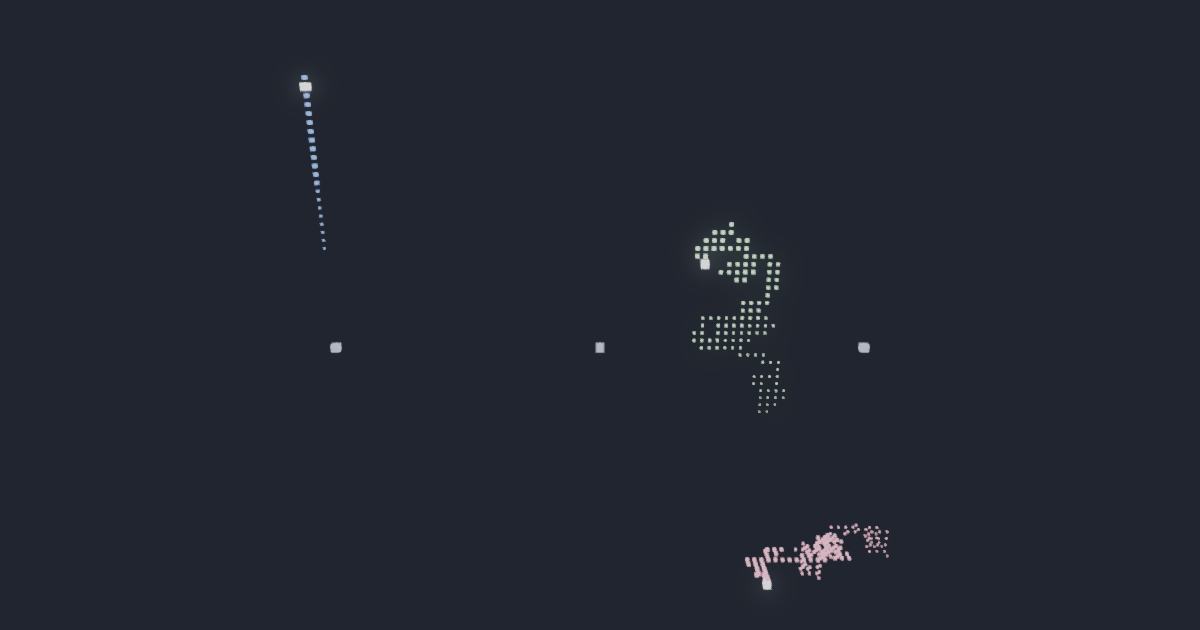
A drunkard staggering on a grid always finds his way home — does a drunken bird in the air? Does a simple random walk return to its origin, does the answer depend on dimension, and can the exact 3-D return probability be measured from nothing but the walk itself?
Units: dimensionless probability (p₃ = 1 − 1/W₃, W₃ = (√6/32π³)·Γ(1/24)Γ(5/24)Γ(7/24)Γ(11/24) = 1.5163860591519778 — Watson 1939, Glasser & Zucker 1977)
▶ Run this simulationRead how it works
Pólya recurrence — the drunkard comes home, the drunken bird doesn't, and the bird's exact odds emerge from pure counting: with NOTHING coded but random-walk steps (a 1-D DP convolution kernel, verified independent counting routes, and live Monte-Carlo walkers), the probability that a 3-D simple random walk ever returns to its start comes back p₃ = 0.3405373295452 vs Watson/Glasser–Zucker 0.3405373295510 (rel 1.7e-11); 24×50000 real random walks agree at z = 2.28 (0.341353 ± 3.6e-4); Pólya's dichotomy EMERGES from the same series — S₁ diverges as N^0.4999, S₂ diverges as (1/π)·ln N with the 1/π emergent to 2.7e-4, S₃ converges — so d = 1, 2 return with certainty while d = 3 escapes; the dimension sweep lands Montroll's p₄ and p₅ to 1e-13; and the 'dimensions don't couple' rival (all three axes stepping independently each turn) is falsified by its own cleanly recovered constant 0.2822299889 = 1 − 4π³/Γ(1/4)⁴, 17% below p₃ and 56 SE from it
Two independent recoveries, both pure counting, no closed form of anything under test in either path. DETERMINISTIC: u_n = P(at origin at step n) built by DP convolution of the ±1/2 kernel in 1-D; 2-D via the exact rotation mapping u₂ = u₁² (the (x+y, x−y) coordinates are independent 1-D walks) verified in-script against a direct 2-D DP; 3-D via the axis-choice decomposition u₃_n = Σ_a C(n,a)(1/3)^a(2/3)^(n−a) u₁_a u₂_(n−a) verified against a direct 3-D DP; W₃ = Σ u₃_n with the tail fitted from the series' own last decade (K·n^(−3/2)(1+b/n), self-calibration); p₃ = 1 − 1/W₃ via the renewal identity f_n = u_n − Σ f_k u_(n−k) (generic renewal theory, itself verified against an absorbing-origin 3-D DP that plays the walk with the origin as a trap). STOCHASTIC: 24 seeds × 50000 live random walks stepping one uniformly-chosen axis ±1 per step (the module's substrate), return fraction by step 1024 plus the deterministic tail correction. 19 gates in scripts/polya-derisk.mjs (~17 s): recovery at two series lengths, three substrate cross-checks at 1e-13, emergent n^(−3/2) and N^(−1/2) exponents, MC unbiasedness + CLT spread, the three-way dichotomy, the d = 4, 5 sweep, the rival's own constant deterministically AND by live diagonal-walk MC, and a scoring self-test. HONEST-MODULE CERTIFICATION (gates I–L, added at the rung-6 climb): the derisk EXECUTES the shipped PolyaWalkModule.ts headless at &seed=7 — sha-pinned + type-stripped, init measurement and 2400-call lockstep bit-for-bit vs an independently-coded replica, the displayed extrapolation priced (deterministic estimator bias −7.7e-6 + noise located in the module's own 12-seed scatter), and the counted path census-proven answer-free. Known values live in scripts/oracles/polya.reference.json, loaded ONLY to score. ?world=polya.
Pólya's recurrence theorem (Math. Ann. 84, 149 (1921)): the simple random walk on Z^d is recurrent for d ≤ 2 and transient for d ≥ 3, with the d = 3 return probability p₃ = 1 − 1/W₃ given by Watson's 1939 triple integral, closed by Glasser & Zucker (PNAS 74, 1800 (1977)), and the higher-d values computed by Montroll (J. SIAM 4, 241 (1956)). It VALIDATES, not derives: the generators are (i) the bare transition kernel of the walk convolved into exact occupation probabilities and (ii) literal Monte-Carlo walkers — Watson's integral, the Gamma closed form, the theorem, and every scored constant appear ONLY in the reference file. Non-circularity is triple-checked in-script: the decomposition series is verified against a direct 3-D lattice DP (1e-16), the renewal identity against an absorbing-origin DP (1e-16), and the scoring self-test confirms a falsified reference flips the exit code with the recovered value unchanged. The decisive control is quantitative: the independent-axes rival walk recovers a DIFFERENT Watson constant (0.28223, 17% low), so nothing in the machinery gravitates to p₃. This is the lab's first pure-probability-theorem oracle beyond Monte-Carlo constants (buffon recovered π; this recovers a THEOREM with a constant attached — the recurrence/transience phase boundary at d = 2/3 plus the exact escape odds), and it grounds the stat arc's other walk worlds (saw, galton, perrin).
The module (?world=polya) is honest at its core — now proven by execution, not argued: its on-screen d = 3 asymptote is a genuine measurement (6000 walks per dimension to horizon 8192, R(N) at 13 checkpoints, linear N^(−1/2) extrapolation over N ≥ 256 — the same estimator form this oracle proved emergent in gate C'), and its live walkers use the identical substrate the oracle MC validates. Disclosed systematics, all now MEASURED (gate K): (1) the extrapolated display carries seed-to-seed noise of ±6.6e-3 (12-seed scatter; the binomial SE 6.1e-3 on R(8192) amplified ×1.09 by the extrapolation — the old 'roughly ±0.008' estimate confirmed), while the estimator's deterministic bias is only −7.7e-6 — the shown value's whole gap from p₃ is honest sampling noise, and seed 7's 0.343 sits at +0.35σ of it; (2) the on-screen 'Pólya 0.3405' label, the theory row and the chart's dashed guide are the KNOWN VALUE as visual references, not measurements — disclosed and census-pinned to display surfaces only (gate L); (3) the module never measures the dichotomy quantitatively (its d = 1, 2 lanes show R climbing but no 1/π or √N law) — those are oracle-only observables. Module untouched this run (zero-edit certification).
Construction lesson re-confirmed (KdV's lesson applied): the reference value I first recalled for p₃ was wrong in the 11th digit (…95500986 vs the true …95509990) and p₄'s published 10-digit rounding differed from the exact value at 4e-10 — both caught BEFORE authoring the oracle by evaluating the Glasser–Zucker and Γ(1/4) closed forms independently (math.lgamma) and checking the counting series against them. Estimator note: the MC tail correction (p₃_det − R_det(horizon)) comes from the deterministic series, not from fitting the noisy MC curve — self-calibration per the ROUTINES.md checklist, with the known value never entering; the module's own extrapolation-fit approach is the noisier alternative and its ±0.008 scatter is why the oracle separates the two recoveries.
npm run derisk -- polya (scripts/polya-derisk.mjs)scripts/oracles/polya.reference.jsonG. Pólya, 'Über eine Aufgabe der Wahrscheinlichkeitsrechnung betreffend die Irrfahrt im Straßennetz', Math. Ann. 84, 149–160 (1921); G. N. Watson, 'Three triple integrals', Q. J. Math. 10, 266–276 (1939); M. L. Glasser & I. J. Zucker, 'Extended Watson integrals for the cubic lattices', PNAS 74, 1800–1801 (1977); E. W. Montroll, 'Random walks in multidimensional spaces, especially on periodic lattices', J. SIAM 4, 241–260 (1956); S. R. Finch, Mathematical Constants (CUP 2003), §5.9.