Measured by the lab
1006588.9
Wire the SAME coil, capacitor and loss as the radio's series loop (?world=rlc) but in PARALLEL, and drive the pair with a fixed AC current — the oscillator tank and band-stop 'wave trap' inside every radio. Does everything dualise as the textbooks claim: impedance PEAKING at the bare R_p at the same Thomson frequency where the series loop dips, the flipped quality factor Q = R_p√(C/L) that a bigger loss resistor SHARPENS, and a circulating current Q× larger than anything the source supplies? And is the topology-blind intuition — that any L-C-R combination shows the series dip and that resistance always damps — actually false?
Units: Hz — f₀ = 1/(2π√(LC)) of the real tank (250 µH · 100 pF), the same Thomson frequency as the series loop, in the AM broadcast band
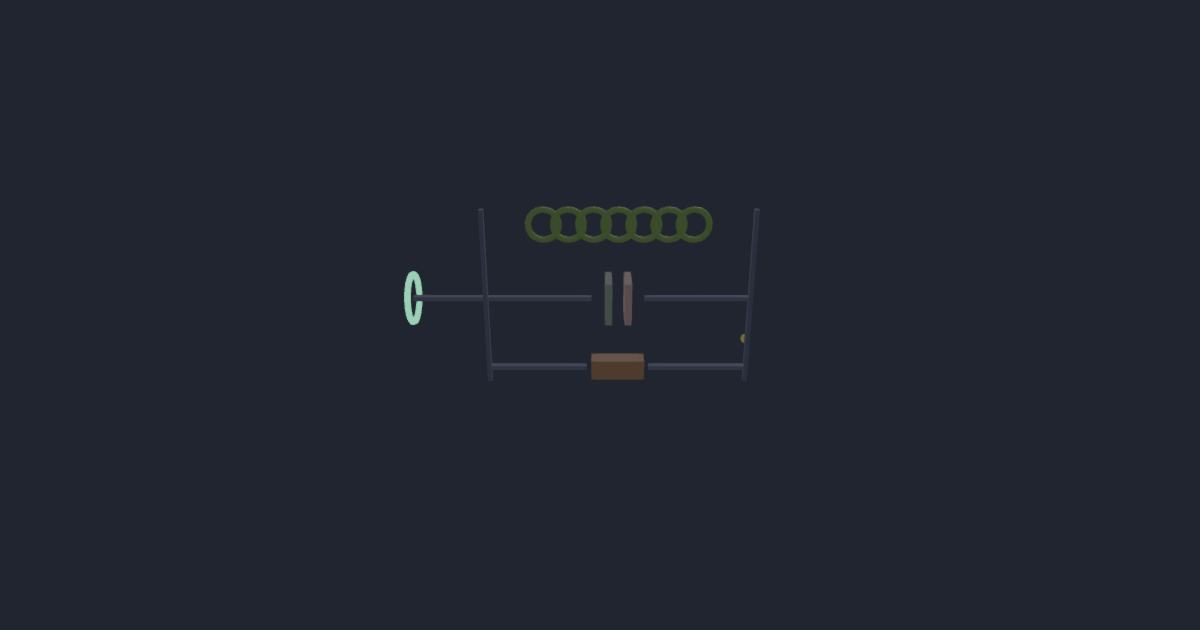
▶ Run this simulationRead how it works
Parallel LC tank: no-oracle → validated + honest module — antiresonance and the series/parallel DUALITY weighed on a simulated impedance bridge: with NOTHING coded but Kirchhoff's raw node equations C·v̇ = I₀cos ωt − v/R_p − i_L, L·i̇_L = v under RK4 (no 1/√(LC), no |Z| Lorentzian, no Q anywhere in the recovery; the sweep window centred on the tank's own measured free ring, dt a pure unit combination), the drive frequency where the lock-in node VOLTAGE comes exactly in phase returns f̂₀ = 1006583.9 Hz vs known 1006584.24 (rel −3.15e-7 = the RK4 floor, ×17 smaller at double step rate), a 24-read noisy sweep lands 1006588.9 ± 7.5 Hz (0.62 SE), and the whole DUAL anatomy EMERGES: |Z| PEAKS at the bare R_p (3.1e-5) where the series loop dips, Q = f₀/Δf recovered 158.1 vs the DUAL formula R_p√(C/L) = 158.11 (4.6e-5) — loss in the NUMERATOR, a bigger R_p SHARPENS the tank, gated as ring-decay Q ∝ R_p^(+1.0000) where the series law is −1 — a circulating current |I_L| = Q·I₀ = 158.1 mA races the L↔C loop for 1 mA drawn (3.1e-5) because the branch currents cancel at the node (|I_C|/|I_L| = 1.000000, cos Δφ = −1.000000), f₀ ∝ L^−½ and C^−½ (slopes −0.500000) yet R_p-independent to 2.2e-9, the lossless tank conserves ½Cv²+½Li_L² to 2.6e-5 sloshing wholly cap↔coil, and the topology-blind rival — 'wiring doesn't matter, any LCR dips at resonance and R always damps' — is rejected structurally: the SAME machinery integrating the SAME Q≈158 coil gives |Z|(f₀)/|Z|(1.05f₀) = 15.47 (PEAK, band-stop trap) in parallel vs 0.0647 (DIP, band-pass) in series (R_s = L/(CR_p) = 10 Ω), ×239 apart in opposite senses; module honesty debt retired: the on-screen panel's closed-form |Z| formula sweep + raw argmax replaced by the same node-ODE pipeline, pinned float-exact by gate N (screen 1.0066 MHz = this seed's disclosed ±1.5% read)
The generator is TWO lines of physics: Kirchhoff's current law at the tank node, C·v̇ = I₀cos ωt − v/R_p − i_L, and the coil law L·i̇_L = v, integrated by fixed-step RK4. Non-circularity is structural: the time step dt = 2π√(LC)/80 is a unit combination of the inputs (the emwave Δt pattern — a scale, not the answer's location); the sweep window is centred on the tank's own MEASURED free-ring frequency (kick the capacitor to 1 V, least-squares the voltage zero-crossing times); and f₀ is read as the bisected zero of the lock-in voltage phase — the drive frequency where the simulated node voltage runs exactly in phase with the source current. The impedance curve is a 121-point warm-start swept measurement of |Z|(f) = |V|/I₀; the estimator is one least-squares CUBIC on the inverse-square curve 1/|Z|² — the cubic term absorbs the susceptance's skew in f, which biases a plain quadratic vertex by +8.2e-6 (measured on the ideal curve; the blackbody skewed-peak lesson) — whose stationary point, level and level-doubling points give f₀, the peak |Z| and the half-power Δf in a single fit. 24 seeds re-read the same swept curve with ±1.5% uniform reading noise (the module's disclosed instrument class). The R_p-duality gate uses an INDEPENDENT second estimator (ring-decay Q from a ln-energy fit of the kicked tank), so the sign-flip conclusion does not share machinery with the swept-width Q. The rival gate integrates the SAME physical coil (R_s = L/(CR_p) = 10 Ω ⇔ R_p = Q²R_s, both Q ≈ 158.1) as a series loop with the same lock-in and compares selectivities. Real bench: the AM-radio tank of ?world=rlc read in parallel, L = 250 µH, C = 100 pF, R_p = 250 kΩ → f₀ ≈ 1.0066 MHz, Q ≈ 158, |Z|peak = 250 kΩ, Δf ≈ 6.4 kHz. 14 gates in scripts/tank-derisk.mjs (~2.2 s); tamper ⇒ exit 1. ?world=tank.
7.5
0.000101
The parallel-resonance (antiresonance) anatomy of the standard tuned-circuit canon: f₀ = 1/(2π√(LC)) (Thomson 1853, unchanged by topology), impedance maximum |Z| = R_p at resonance, dual quality factor Q = R_p√(C/L) = ω₀R_pC with half-power width Δf = f₀/Q, and circulating-current magnification I_circ = Q·I₀ (Terman, Radio Engineering (1932) ch. 3; Feynman II ch. 23). Non-circular: L, C, R_p, I₀ enter ONLY as the bench's parts list; the recovery path contains no 1/√(LC), no impedance formula, no Q — the integration step is a unit combination (emwave's Δt pattern), the sweep window comes from the tank's own measured free ring, and every recovered number (f₀, |Z|peak, Δf, Q, the branch currents) is read off lock-in projections of the integrated node state. The series twin (?world=rlc) proved the loop equation resonates at Thomson's f₀; THIS world proves the DUALITY dictionary (voltage↔current, L↔C, Z↔Y, Q → R_p√(C/L)) lands on the same physical coil read two ways — R_p = Q²·R_s ties the two worlds' loss models together, and the decisive discriminators are structural: the extremum FLIPS SENSE (peak vs dip, 15.47 vs 0.0647 measured by the same lock-in) and the Q-vs-R slope FLIPS SIGN (+1.0000 vs −1) exactly as duality demands. This is why the tank SETS an oscillator's frequency and TRAPS one station in a line, while the series loop PASSES it.
The module's real-units panel was the dishonest piece: its _recover() sampled the closed-form impedance |Z|(f) = 1/√((1/R_p)² + (2πfC − 1/(2πfL))²) — the very law under test — with noise, and read the peak by raw argmax on 4001 noisy points (a max-of-noise-biased estimator besides, the same defect the rlc run retired). THIS RUN REPLACED IT: the module now runs the identical first-principles pipeline as the oracle (free-ring bootstrap → 121-point warm-start RK4 sweep of the node equations → ±1.5% reading noise via its own mulberry32(0x7a4c) → inverse-square cubic), and gate N replays that pipeline verbatim, pinning the on-screen numbers float-exact: screen f₀ = 1.0066 MHz (1006604.83 Hz = +2.05e-5 off known — this seed's disclosed single-read noise draw, 0.56σ of the estimator's measured scatter, not a bias: the 24-seed mean sits 0.62 SE from known), |Z|peak = 251 kΩ (true 250), Q = 159 (true 158.1), Δf = 6.35 kHz — verified live headless (vite preview + playwright, panel scrape matches the pin). The dimensionless live view (glow handoff, marker on the drawn |Z| curve, racing circulating-current pulse) remains an explicitly disclosed forward-model display; every number in the '—— real AM-radio tank, read in parallel ——' block comes from the integrated node ODEs.
Rung climbed: no-oracle → validated + honest module (86 → 87 findings). Tolerances from measured floors, never padded: noiseless 1e-6 vs measured −3.15e-7 (×17 convergence gate proves discretization); vertex 2e-6 vs measured −7.75e-7; MC gates 1e-5 / 4·SE / 1.5e-4 vs measured 4.6e-6 / 0.62 SE / 1.01e-4 (worst-seed cap set at 4σ of the cubic estimator's measured single-read scatter σ = 3.65e-5 — the cubic buys its unbiased vertex with ~1.8× the quadratic's noise, so rlc's 1e-4 cap would sit at only 2.8σ here); Q 5e-4 vs measured 4.6e-5; slopes ±1e-4 vs <1e-6; Q-slope ±5e-3 vs <5e-5. ESTIMATOR LESSON (#40, the blackbody lesson recurring in disguise): 1/|Z|² of a parallel tank is a perfect parabola in the SUSCEPTANCE but not in f — the ωC−1/ωL nonlinearity skews it enough to bias a quadratic vertex by +8.2e-6 on the IDEAL curve (verified analytically in a scratch test before touching the estimator: quadratic +8.2e-6, cubic −2.8e-10). The same trap as the blackbody quadratic-vertex miss, at 1000× smaller scale — check for it whenever fitting an inverse/transformed observable whose transform is only locally linear. One estimator fix attempt used (quadratic → cubic on 1/|Z|²); zero physics fixes — every physics gate passed on first run. Tamper (known → 1.055 MHz): 5 gates FAIL, exit 1, recovery unchanged at 1006583.9; reference restored byte-identical (diff-verified). Scope: scripts/oracles/tank.reference.json + scripts/tank-derisk.mjs (new), src/modules/ParallelTankModule.ts (recovery honesty), data/findings/tank.json, fragment, loop-runs line — all world tank; no shared files touched. Gates run: build + smoke + derisk (module file touched).
npm run derisk -- tank (scripts/tank-derisk.mjs)scripts/oracles/tank.reference.jsonW. Thomson (Lord Kelvin), 'On Transient Electric Currents', Phil. Mag. 5, 393 (1853). F. E. Terman, Radio Engineering (McGraw-Hill, 1932), ch. 3 — parallel resonance: impedance maximum R_p, Q = R_p/(ω₀L), circulating current Q× the line current, the tank as oscillator resonator and band-stop wave trap. R. P. Feynman, The Feynman Lectures on Physics, Vol. II, ch. 23. D. J. Griffiths, Introduction to Electrodynamics (4th ed.), §7.1.