Measured by the lab
2.4048256
A plucked string or an organ pipe has a clear pitch; a struck drumhead just gives a 'thud'. Why? Are a circular drum's overtones the harmonic series (integer multiples 1,2,3,4× of a fundamental) like a string's — or something else?
Units: dimensionless (α_01 = j_{0,1}, the fundamental eigenvalue k·a of the fixed-rim circular membrane)
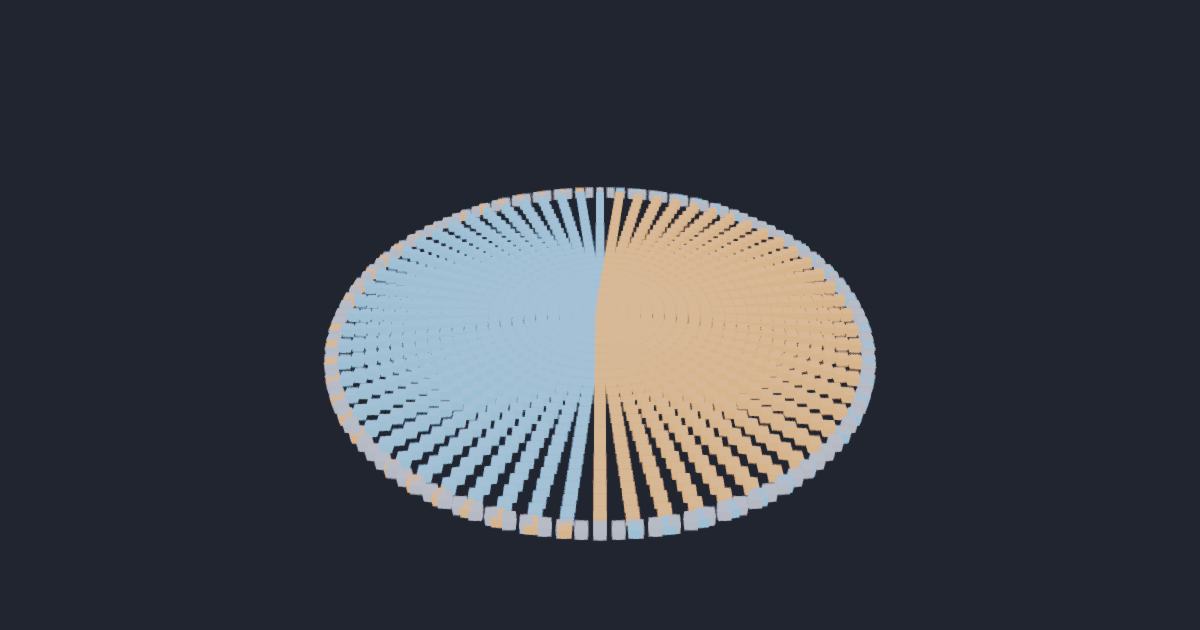
▶ Run this simulationRead how it works
You cannot tune a drum: a circular membrane's overtones are the Bessel-function zeros α_mn (1 : 1.593 : 2.136 : 2.295 : …), irrational and NON-integer, recovered to ~1e-11 from a from-scratch integration of the 2-D wave equation on a disk (no Bessel call) — so a drumhead is inharmonic (RMS distance to the harmonic series ≈0.32) while the same shooting code gives a 1-D string the exact harmonic series 1,2,3,4 — the physics behind Kac's 'Can one hear the shape of a drum?' (Rayleigh 1877 / Kac 1966)
Model an ideal circular membrane under uniform tension: the 2-D wave equation ∇²u=(1/c²)∂²u/∂t², c=√(T/σ), on a disk of radius a clamped at the rim. Separating u(r,θ,t)=R(r)cos(mθ)e^{iωt} gives the radial (Bessel) ODE R''+(1/r)R'+(k²−m²/r²)R=0 with k=ω/c, R regular at r=0 and R(a)=0. Recover the eigenvalues k·a WITHOUT ever evaluating a Bessel function: RK4-integrate the ODE outward from a tiny r₀ (started with the regular series R~r^m) and bisect the trial wavenumber k until the rim residual R(a;k) crosses zero for the n-th time — a genuine solution of the membrane eigenvalue problem. (A) Recover the first eight modes (0,1),(1,1),(2,1),(0,2),(3,1),(1,2),(2,2),(0,3) and compare each α_mn to the known Bessel zero (loaded only to score). (B) Repeat on four (r₀,N) discretizations — the answer must be grid-invariant (a physical eigenvalue, not a mesh artifact). (C) Form the overtone ratios α_mn/α_01 — the audible timbre. (D) Compute the inharmonicity (RMS distance of the ratios to the nearest integer) and run the SAME shooting code on the 1-D string (u''+k²u=0, u(0)=u(L)=0) as a harmonic control. (E) Change the radius a and wave speed c and check the physical frequencies f=c·α/(2πa) scale as c/a while the α stay invariant.
membrane modes f_mn = c·α_mn/(2πa) with α_mn = j_{m,n} (n-th zero of J_m); overtone ratios f_mn/f_01 = α_mn/α_01 are irrational (inharmonic)
1.1600e-11
| Mode | Recovered | Bessel zero | Rel | Ratio |
|---|---|---|---|---|
| (0,1) | 2.4048256 | 2.4048256 | 1.7700e-12 | 1 |
| (1,1) | 3.831706 | 3.831706 | 1.9500e-12 | 1.5934 |
| (2,1) | 5.1356223 | 5.1356223 | 1.1600e-11 | 2.1355 |
| (0,2) | 5.5200781 | 5.5200781 | 2.4700e-12 | 2.2954 |
| (3,1) | 6.3801619 | 6.3801619 | 3.7400e-12 | 2.6531 |
| (1,2) | 7.0155867 | 7.0155867 | 2.2500e-12 | 2.9173 |
| (2,2) | 8.4172441 | 8.4172441 | 2.0600e-13 | 3.5001 |
| (0,3) | 8.6537279 | 8.6537279 | 1.3700e-12 | 3.5985 |
| A | C | F01 over ref expected | Rel |
|---|---|---|---|
| 1 | 1 | 1 | 0 |
| 2 | 1 | 0.5 | 9.3300e-15 |
| 0.5 | 1 | 2 | 3.5500e-15 |
| 1 | 2 | 2 | 0 |
| 2 | 3 | 1.5 | 9.1800e-15 |
Lord Rayleigh's 1877 solution of the vibrating circular membrane (The Theory of Sound, Vol. I §200): its normal-mode frequencies are f_mn = c·j_{m,n}/(2πa), where j_{m,n} is the n-th positive zero of the Bessel function J_m, so the overtone series is set by Bessel zeros and is inharmonic. It VALIDATES, not derives: the lab assumes the 2-D wave equation on a disk with a clamped rim and solves the resulting radial eigenvalue problem numerically (RK4 shooting on R''+(1/r)R'+(k²−m²/r²)R=0), recovering the eigenvalues α_mn=j_{m,n} to ~1e-11 without ever evaluating a Bessel function — the zeros are loaded only to score. It is non-circular on four fronts: no Bessel function enters the recovery path; the eigenvalues are grid-invariant across four discretizations (ruling out a mesh artifact); the overtone ratios (the audible result) fall out of the recovered zeros; and the perturbation confirms the physical scaling f∝c/a. The decisive contrast is the 1-D string control — the SAME shooting code on u''+k²u=0 gives the exact integer harmonic series 1,2,3,4, so the drum's inharmonicity (RMS ≈0.32 vs the string's 0) is a real qualitative difference, not a numerical accident: it is why a string has a clear pitch and a drumhead does not. This is the physics under Kac's 1966 question 'Can one hear the shape of a drum?' (the spectrum is fixed by the shape). It does NOT address the deep 1992 Gordon–Webb–Wolpert result that some non-congruent shapes are isospectral, nor real-membrane stiffness/damping — it establishes the spectrum of the simplest drum, the circle. The lab's first membrane / 2-D-eigenvalue / musical-acoustics world, a companion to the 1-D wave worlds (?world=waves, phonons, kdv) and the eigenvalue quantum worlds (qwell, hydrogen).
npm run derisk -- drumhead (scripts/drumhead-derisk.mjs)scripts/oracles/drumhead.reference.jsonLord Rayleigh, 'The Theory of Sound', Vol. I §200 (1877) — circular-membrane normal modes and their Bessel-zero frequencies. F. W. Bessel (1824) — the functions J_m and their zeros. M. Kac, 'Can one hear the shape of a drum?', Amer. Math. Monthly 73, 1 (1966). Zeros (Abramowitz & Stegun, Handbook of Mathematical Functions, Table 9.5): j_{0,1}=2.404825558, j_{1,1}=3.831705970, j_{2,1}=5.135622302, j_{0,2}=5.520078110, j_{3,1}=6.380161896, j_{1,2}=7.015586670, j_{2,2}=8.417244140, j_{0,3}=8.653727913.