Measured by the lab
2.4048256
A plucked string or an organ pipe has a clear pitch; a struck drumhead just gives a 'thud'. Why? Are a drum's overtones the harmonic series (1,2,3,4×) like a string's — or something else?
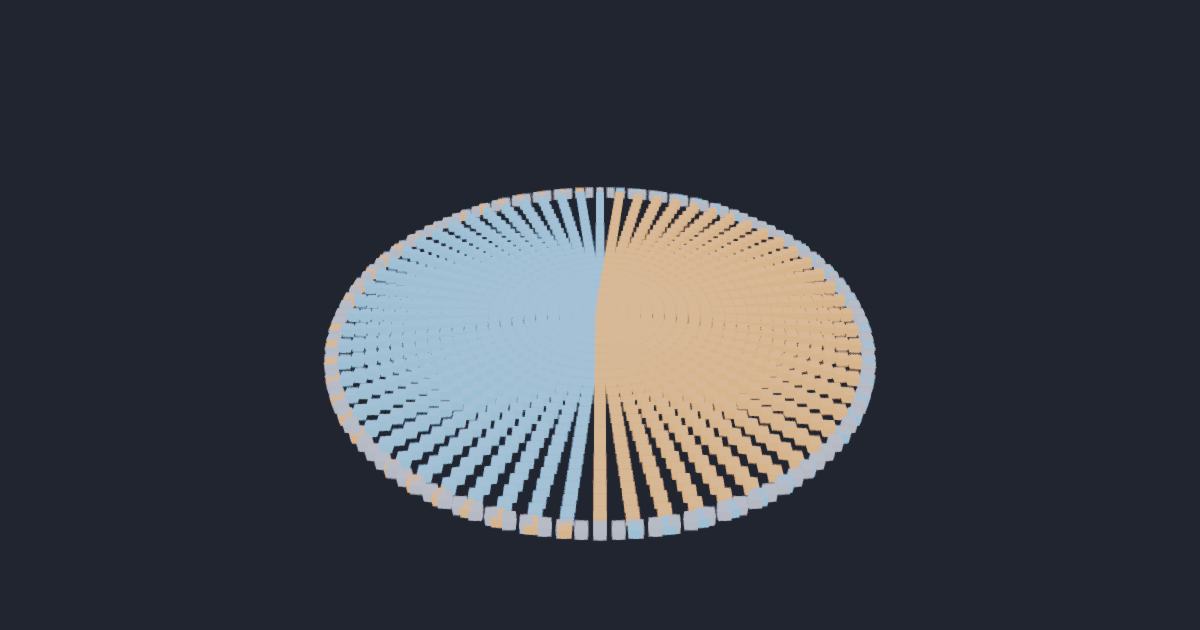
▶ Run the simulationSee the measured result
Units: dimensionless (α_01 = j_{0,1}, the fundamental eigenvalue k·a of the fixed-rim circular membrane)
Model an ideal circular membrane under tension: the 2-D wave equation ∇²u=(1/c²)∂²u/∂t² on a disk clamped at the rim. Separating u=R(r)cos(mθ)e^{iωt} gives the radial ODE R''+(1/r)R'+(k²−m²/r²)R=0 with R(a)=0. Recover the eigenvalues k·a WITHOUT ever evaluating a Bessel function: RK4-integrate the ODE outward from a tiny r₀ (regular series start) and bisect the trial wavenumber k until the rim residual R(a;k) crosses zero for the n-th time. Do this for the first modes (0,1),(1,1),(2,1),(0,2),(3,1),(1,2), check the answer is invariant across four grid discretizations, and run the SAME shooting code on a 1-D string (u''+k²u=0) as a harmonic control.
the Bessel-function zeros α_mn (j_{0,1}=2.4048, j_{1,1}=3.8317, j_{2,1}=5.1356, j_{0,2}=5.5201, …) — recovered to ~1e-11 from the membrane eigenvalue problem, with no Bessel call in the solver (the zeros are loaded only to score). The overtone ratios f_mn/f_01=α_mn/α_01 come out 1 : 1.593 : 2.136 : 2.295 : 2.653 : 2.917 — irrational and NON-integer. The drum's RMS distance from the nearest harmonic (integer) is ≈0.32, versus exactly 0 for the 1-D string control, whose overtones are the perfect series 1,2,3,4. The first overtone is 1.593× the fundamental (a dissonant near-minor-sixth), not the 2× octave a string gives — which is precisely why a drumhead has no definite pitch. Perturbation: change the radius a and wave speed c=√(T/σ); the dimensionless α_mn stay fixed while every physical frequency scales as c/a (a bigger or looser drum sounds lower but keeps the same inharmonic timbre). Rayleigh's 1877 circular-membrane analysis and the physics behind Kac's 1966 'Can one hear the shape of a drum?'
Why a guitar plays a note and a drum plays a thud, computed rather than asserted. Both instruments answer the same question — what shapes can vibrate while the edge stays still — and the answer splits on which special function the boundary lands you in. Clamp a string and you need sin(kL) = 0; the zeros of a sine are π, 2π, 3π …, evenly spaced, so the overtones are 1, 2, 3, 4× the fundamental and the ear finds a common divisor to call the pitch. Clamp a circular membrane and you need J_m(ka) = 0, and the zeros of a Bessel function are spaced by nothing in particular: 1 : 1.5933 : 2.1355 : 2.2954 : …, irrational, with no common divisor for the ear to lock onto. That is the whole mechanism, and this page computes both sides of it. None of the Bessel zeros is stored here — J_m is summed from its own power series and each zero is bisected out of that sum, so j₀,₁ = 2.4048255576957729 is assembled at runtime and carries its own error bar, taken from the residual and the exact recurrence J_m' = (J_{m−1}−J_{m+1})/2 rather than from a table. It is the same refusal that makes the simulation above non-circular, which RK4-shoots the radial equation outward and bisects the rim residual with no Bessel call in the recovery path at all. What the calculator gives you: the fundamental from tension, areal density and radius; the tension or the radius needed to tune a head to a target pitch; the mode ladder with every overtone in cents; and the inharmonicity against a string control solved by the same clamp logic. One caution it does not hide — 'the first eight modes' is not one set. This world's oracle lists (0,1)(1,1)(2,1)(0,2)(3,1)(1,2)(2,2)(0,3) and skips (4,1), the seventh by frequency; scored on that list the inharmonicity is 0.3181 and on the frequency-complete eight it is 0.2899, and the 'lab' direction prints both rather than picking one. Five things this is not: air loading, which drags a slab of air with a real head and pulls the lowest modes down several percent; bending stiffness, which a real head has and an ideal membrane does not; the enclosed cavity and kettle of a two-headed drum or a timpano, which is precisely how timpani are given a definite pitch — by changing the ratios, not by tuning; the strike point and how hard each mode is actually driven; and damping, since every frequency here belongs to a mode that rings forever. This is the ideal membrane Rayleigh solved in 1877, and the physics under Kac's 1966 question of whether one can hear the shape of a drum.
f_mn = (j_{m,n}/2πa)·√(T/σ) · j₀,₁ = 2.4048255576957729 (bisected here, not stored) · overtone ratios j_{m,n}/j₀,₁ = 1 : 1.5933 : 2.1355 : 2.2954 : … · RMS distance to the harmonic series = 0.3181 (a string's is 0)