Measured by the lab
1.99999
Two crossed polarizers pass nothing. Insert a THIRD polarizer between them — can adding an absorber brighten a dark field, and does the whole intensity chain really follow Malus's I = I₀cos²Δθ with nothing but 'a polarizer transmits the field component along its axis' as input?
Units: dimensionless (Malus exponent; companions: T₁ = 1/2, T₃ᵖᵉᵃᵏ = 1/8 at φ* = 45°)
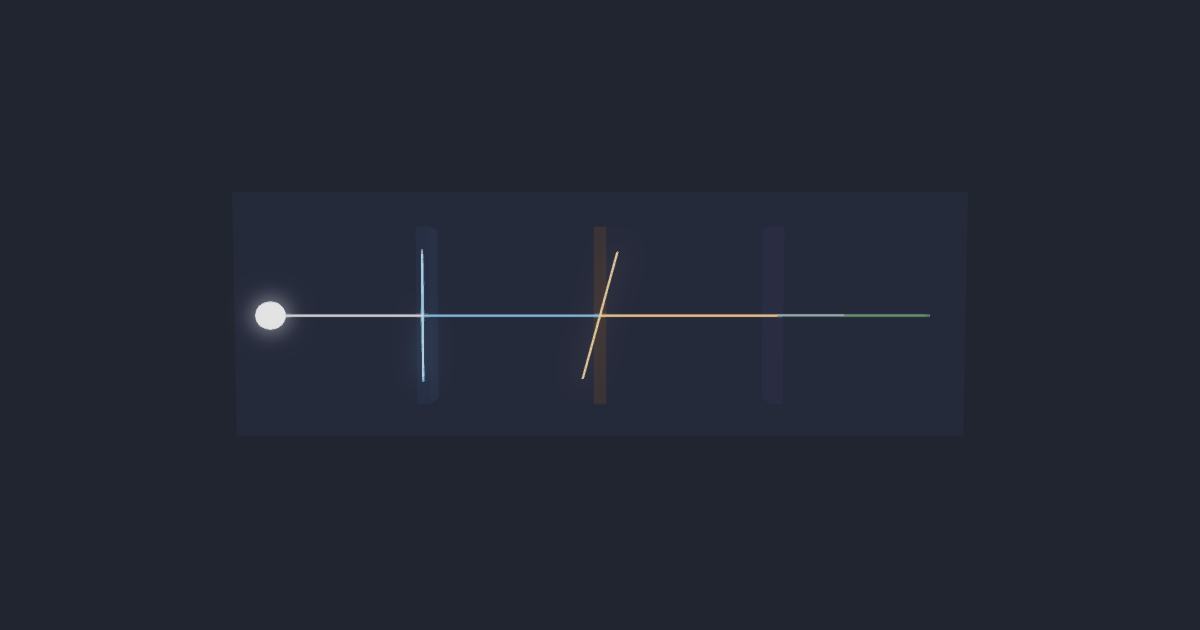
▶ Run this simulationRead how it works
The plate that lights a dark field: with a polarizer coded ONLY as a projector E′=(â·E)â, Malus's exponent comes back as n = 1.99999 ± 0.0006, unpolarized light halves to 0.50011 ± 0.0001, and sliding a third plate between crossed polarizers lifts the output from exactly 0 to a peak of 0.124962 ± 0.00002 at φ* = 44.99° ± 0.02 (known 1/8 at 45°) — while the sieve rival that only removes light can never light the field at all
Code the polarizer as a pure PROJECTOR and nothing else: E′ = (â·E)â, intensity = |E|². No cos² law, no ½, no ⅛ appears anywhere in the generator or the recovery — Malus's exponent, the unpolarized half, and the three-polarizer curve must all EMERGE from chained dot products over an ensemble of unit fields at uniform random polarization angle (stratified 4096 for ensemble means; genuine 2e5-realization Monte-Carlo for the ½ and the photon-counting twin). Recover (i) the exponent n from a log–log fit of the noisy analyzer sweep I vs (â₁·â₂) over 12–66°; (ii) the three-polarizer peak (φ*, T₃) from a ±1%-noise scan of φ on a 0.25° grid — located by a windowed least-squares quadratic around a smoothed argmax, because the ⅛sin²2φ peak is FLAT (curvature −1 rad⁻²; a naive 3-point parabolic refine wanders ±3° under 1% noise, which is exactly what the live module's on-screen argmax does); (iii) the same peak with the outer analyzer tilted to θ₃ ∈ {40,60,75,90}°. All knowns are loaded from scripts/oracles/malus.reference.json only to score; 24 deterministic LCG seeds. ?world=malus.
I(Δθ) = I₀cos²Δθ (Malus 1809); unpolarized → ½; crossed + inserted plate → T₃(φ) = ⅛sin²2φ, peak 1/8 at 45° — a polarizer PROJECTS the surviving field onto its axis, it does not merely remove light
0.00061
0.013
3.9000e-16
24
Malus's law (É.-L. Malus, 1809): the transmitted intensity of polarized light through an analyzer at Δθ is I₀cos²Δθ — found with calcite and reflected sunlight before the wave theory of light existed. It VALIDATES, not derives: the lab assumes only that a polarizer transmits the vector component of the field along its axis (E′=(â·E)â, Hecht §8.2) and shows (i) the exponent 2, the unpolarized ½, and the three-polarizer ⅛sin²2φ all EMERGE from chained dot products, never coded; (ii) the paradox is real and quantitative — crossed plates pass 0, inserting a third at φ lights the field on the measured curve peaking at 1/8 at 45°, tracking the tilted-analyzer law φ*=θ₃/2, ½cos⁴(θ₃/2) across θ₃∈[40°,90°]; (iii) the intuition 'an absorber can only dim' — formalized as the keep-angle sieve, the only keep-angle rule consistent with the dark field — is falsified by that same lit field, so a polarizer PROJECTS (re-aligns), it does not filter; and (iv) a single-photon Born-rule twin (pass w.p. |⟨θ|ψ⟩|², collapse on pass — Dirac §I.2) reproduces the classical curve from raw counts: the cos² of 1809 is the Born rule of 1926, and the polarizer staircase (→ ½ as N→∞) is the projective-measurement limit behind the quantum Zeno effect. It does NOT model real polarizer extinction ratios, absorption anisotropy (Polaroid dichroism), or partial polarization — ideal projectors only; the polarization-by-reflection route to the same physics is ?world=brewster, and the entangled two-analyzer sequel is ?world=bell, whose E(a,b)=−cos(a−b) correlations no keep-angle model can reach at all.
The on-screen peak angle is plateau-limited, and the earlier ESTIMATED '±~3°' wander is now MEASURED BY EXECUTION: re-running the module's own naive argmax+parabolic estimator across the oracle's 24 seeds at the same ±1% noise gives wander SD 0.70°, max |dev| 1.31°, both inside the ceiling DERIVED from the noise level alone (a noise realization can only relocate the argmax where T ≥ (1−2a)·Tmax ⇒ acos(√(1−2a))/2 = 4.07°; the 1%-plateau half-width is acos(√(1−a))/2 = 2.87°). The executed screen value 45.77° sits +0.77° from 45° (inside the 2.87° plateau) and +0.78° from the oracle's windowed-LSQ 44.992° ± 0.017 — a display-estimator systematic, not a physics error; the shown height 0.1249 is the law evaluated at the plateau-limited angle (−0.07% from 1/8) and the shown exponent 1.994 sits 2.1 per-seed SD from 2 (measured naive-fit spread 2.0000 ± 0.0027). One module defect was found and fixed by the execution cert: render() guarded the HUD with a post-increment `_frame++ % 4`, then checked `_frame % 8 === 0` for the chart — always odd there, so the chart's 'live' φ-marker had been frozen at its init position (0°) since the world landed; the cadence now fires on the post-increment value and gate L proves every chart write bit-equals the replica SVG and the marker moves (verified live in a headless browser: marker 306.6→131.4 px as φ swept 83.4°→29.4°).
npm run derisk -- malus (scripts/malus-derisk.mjs)scripts/oracles/malus.reference.jsonÉ.-L. Malus, 'Sur une propriété de la lumière réfléchie', Mém. Phys. Chim. Soc. d'Arcueil 2, 143 (1809). E. Hecht, Optics (5th ed., Pearson 2017), §8.2 — Malus's law, natural light, the three-polarizer arrangement. P. A. M. Dirac, The Principles of Quantum Mechanics (4th ed., Oxford 1958), §I.2 — photon polarization, Born probability and the projection postulate.