Measured by the lab
1.99999
Two crossed polarizers block all light. Slide a third polarizer between them — does adding another absorber let light through?
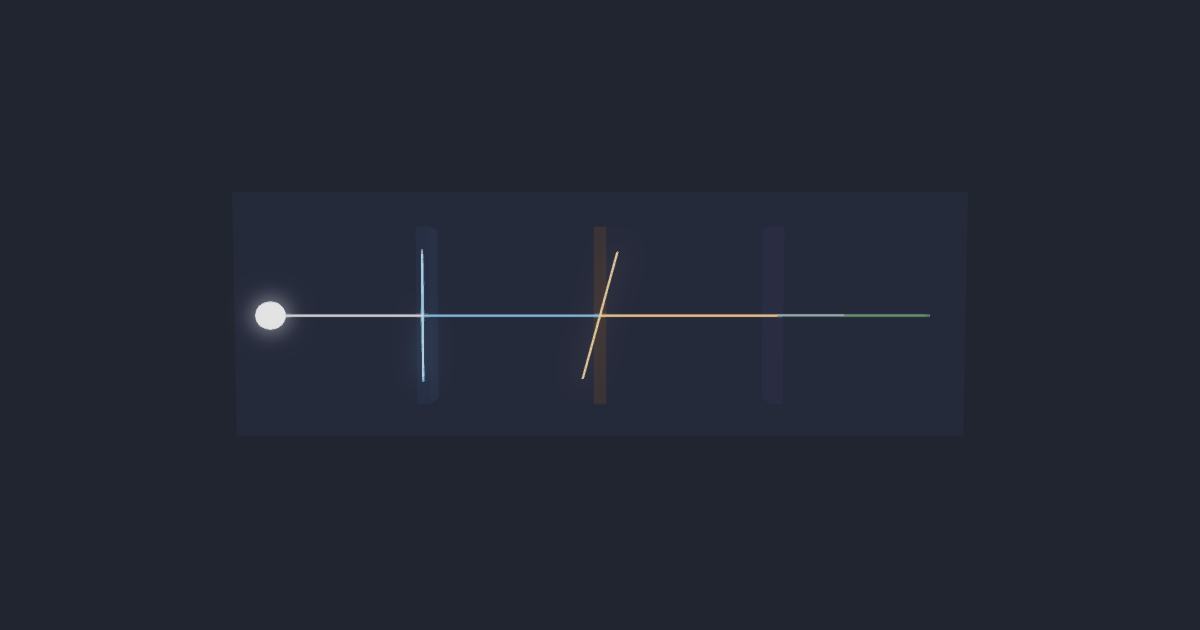
▶ Run the simulationSee the measured result
Units: dimensionless (Malus exponent; companions: T₁ = 1/2, T₃ᵖᵉᵃᵏ = 1/8 at φ* = 45°)
Run an optical bench (unpolarized → P1 at 0° → P2 sweeping 0–90° → P3 at 90°, crossed with P1); apply Malus's law I=I₀cos²θ across each successive pair and read the output beam's intensity. Recover the peak angle and height, plus Malus's exponent, from noisy samples.
Malus's law I=I₀cos²θ and the three-polarizer paradox — crossed P1⊥P3 give zero, but inserting P2 at 45° makes the output LIGHT UP to T₃=⅛sin²2φ, peaking at exactly 1/8 at 45°. Adding a plate raises transmission from 0 to 12.5% because a polarizer PROJECTS the field onto a new axis, it does not merely filter — the identical cos² is Born's rule |⟨θ|0⟩|², foreshadowing quantum measurement. The intensity branch of the optics arc, after Brewster.
Two crossed polarizers pass nothing. Slide a THIRD one between them and the field lights up — which is the fact that tells you what a polarizer actually is. It does not sieve light; it PROJECTS it, keeping the component along its axis and handing the next plate a direction it can work with. Everything on this page is that one idea, E′ = (â·E)â, followed to its consequences: square the projected amplitude and you have Malus's cos², chain two projections through crossed plates and you get ⅛ at 45° out of a dark field, chain N of them and the loss vanishes as the steps shrink. The exponent is never typed into the direction that measures it. Two intensity readings at two angles, a ratio, two logarithms — and I₀ cancels, so you can weigh Malus's law without knowing how bright the lamp was. Set the I₀ box to zero and that recovery does not move. The two readings default to the simulation's own 12° and 66° sweep points, noise and all, so the answer comes back 1.978833486 and the page prints the −2.1% rather than a tidy 2; the 1.99999 ± 0.00061 this lab actually earned came from all 55 readings across 24 seeds, not from two endpoints. One box carries the rival: sv = 1 is the keep-angle sieve, a plate that can only remove photons, and it predicts the three-polarizer field stays dark at EVERY middle angle — which is the measurement that kills it. The last direction re-runs the simulation's own measurement bit for bit and then prices the 0.77° its on-screen peak sits from 45°, against a plateau width derived from the noise alone. Four things this page will not do — real extinction ratios, Polaroid's absorption anisotropy, partial polarization, and entangled pairs (that is ?world=bell) — are named under the staircase.
I = I₀cos²Δθ · Δθ = arccos √(I/I₀) · n = ln(I₂/I₁)/ln(cos θ₂/cos θ₁) · T₃(φ) = ½cos²φ·cos²(θ₃−φ), peak ½cos⁴(θ₃/2) at φ* = θ₃/2 · T_N = ½cos²ᴺ(θ/N)