Measured by the lab
0.592914
Is there a sharp threshold at which random, independent site occupation suddenly connects across a whole lattice — a phase transition made of pure geometry, with no energy, no dynamics, no temperature?
Units: dimensionless occupation probability (square-lattice site-percolation threshold; no closed form — Jacobsen 2015 graph-polynomial value 0.59274605079210(2))
▶ Run this simulationRead how it works
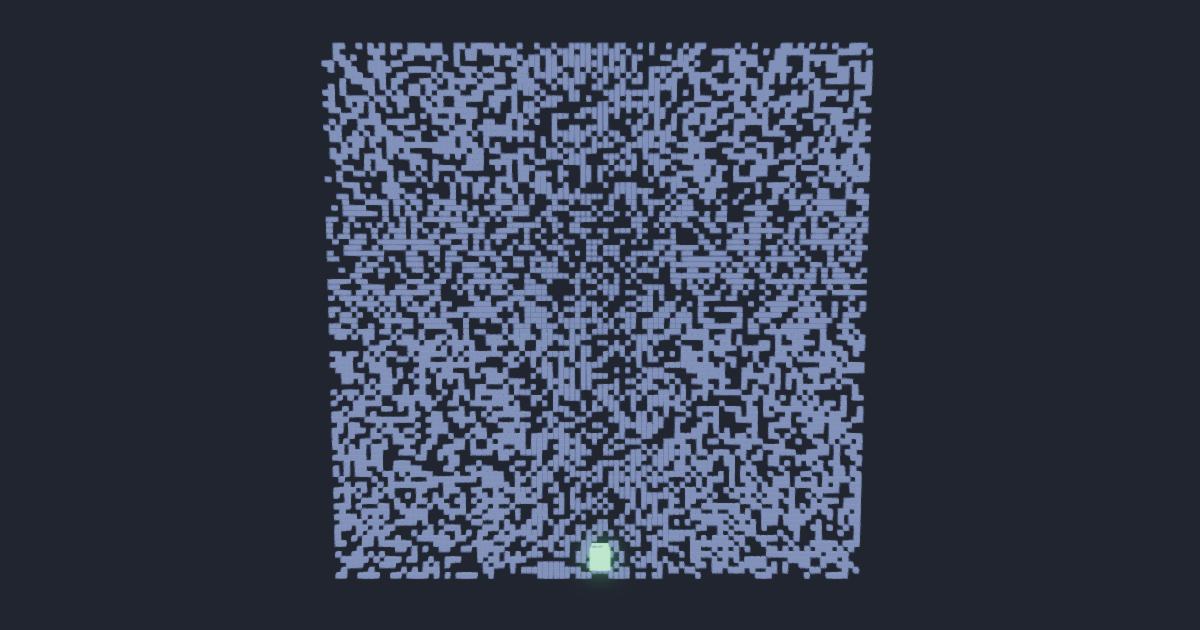
A phase transition with no dynamics at all: random occupation of a square lattice snaps into edge-to-edge connectivity at p_c, recovered as 0.592914 vs 0.59274605 known — by SELF-BOOTSTRAPPED finite-size scaling: the transition WIDTH shrinks as L^(−1/ν) giving ν̂ = 1.367 (known 4/3, never plugged in), and that measured ν̂ extrapolates the crossing points to L = ∞. The leading-order extrapolation carries a real +8.9e-4 corrections-to-scaling floor (measured at 96,000 realizations/size); the canonical run's 1.7e-4 is one favourable draw of it, and the floor is now disclosed on screen and gated. The decisive pair: the SAME pipeline on the triangular lattice recovers the EXACTLY known p_c = 1/2 (Sykes–Essam star-triangle duality) to 1.1e-4 with the SAME exponent (ν̂_tri = 1.370) — the threshold moves with the lattice geometry, the exponent does not (universality). Below p̂_c the largest cluster VANISHES with L (frac 0.091 → 0.016 from L = 24 → 96: only finite islands); above, it is intensive (0.679 → 0.699). A 1-D chain's threshold escapes to 1 (N/(N+1) exactly) — dimension, not randomness, makes p_c < 1. The screen now runs this oracle's own estimator, bit-for-bit.
Every site of an L×L lattice gets an independent uniform threshold u_i; sites are added in increasing-u order into a union-find forest with two virtual nodes (TOP glued to row 0, BOTTOM to row L−1). The u of the site whose addition first connects TOP to BOTTOM is the EXACT spanning threshold of that realization — one O(N log N) pass per lattice, no p-sweep (the threshold form of Newman–Ziff 2000). Across 9,600 realizations per size at L = 16…128: p̄(L) = mean spanning threshold, σ(L) = its width. The recovery is SELF-BOOTSTRAPPED: ν̂ is measured from the log-log slope of σ(L) vs L, then the crossing points p̄(L ≥ 24) are extrapolated linearly in L^(−1/ν̂) to L = ∞. Neither 0.5927 nor ν = 4/3 appears in the recovery — both are loaded from the reference only to score (asserted on the recovery source itself). Controls: the triangular lattice (one diagonal added per cell; p_c = 1/2 EXACT by Sykes–Essam 1964), the order parameter's L-dependence on either side of p̂_c, a 1-D chain (spanning needs every site), and a headless replica of the module's own on-screen Π = ½ sweep estimator at L = 72.
spanning-threshold distribution concentrates at p_c with width ∝ L^(−1/ν); crossing points p̄(L) → p_c as L → ∞
0.000168
| L | P bar | Sigma |
|---|---|---|
| 16 | 0.5891 | 0.06327 |
| 24 | 0.591379 | 0.04762 |
| 32 | 0.591722 | 0.038544 |
| 48 | 0.591988 | 0.028175 |
| 64 | 0.591997 | 0.023211 |
| 96 | 0.5923 | 0.017178 |
| 128 | 0.592612 | 0.013871 |
true
recovered p_c by finite-size scaling fed only by its own measured exponent; p_c and 4/3 are loaded from the reference only to score, gate G asserts the recovery source contains neither, and gate I asserts the shipped module's measurement path names no known value either (KNOWN_PC/KNOWN_NU are a display-only table declared outside it). Tampers all exit 1, each leaving the physics gates A–G green: the reference known_value → 0.55 (A/B, recovery unchanged), the module's sha (I), the spanning condition TOP≡BOT → TOP≡site (H/K/L), the fit window 24 → 16 (H), a fed exponent ν = 4/3 instead of a measured one (H/L), the HUD's digits toFixed(5) → toFixed(3) (J), and the block count 8 → 2 (H). All 12 derisk gates pass in ~134 s.
Broadbent–Hammersley percolation (1957): occupy each site of a lattice independently with probability p; connectivity undergoes a sharp phase transition at a critical p_c — the simplest system in statistical mechanics with a genuine critical point, made of pure geometry (no Hamiltonian, no temperature, no dynamics). This world VALIDATES the square-lattice site threshold p_c = 0.59274605 (Newman–Ziff 2000, Jacobsen 2015) and the exact 2-D correlation-length exponent ν = 4/3 (den Nijs 1979; proven via SLE₆ by Smirnov–Werner 2001), and it is arranged to be NON-CIRCULAR and SELF-BOOTSTRAPPED: the per-realization spanning threshold is exact (sites added in random-threshold order through union-find), the exponent is measured from the width scaling σ(L) ∝ L^(−1/ν), and that measured ν̂ — not the textbook 4/3 — extrapolates the crossing points to the thermodynamic limit. The triangular-lattice control lands on the EXACTLY known p_c = 1/2 (Sykes–Essam 1964) with the same ν̂ — the cleanest possible demonstration that thresholds are non-universal geometry while exponents are universality-class properties, the same structure the logistic world found in Feigenbaum's δ (same constant for the sine map, different constant for a quartic maximum). The order-parameter gate shows what 'infinite cluster' means operationally: below p_c the largest cluster's lattice fraction vanishes with system size; above, it is intensive. The 1-D control (threshold = max of N uniforms → 1) is the connectivity analogue of the absence of 1-D phase transitions. Percolation's anatomy — order parameter, diverging correlation length, universal exponents — is the same as the Ising magnet's (?world=ising) with every dynamical ingredient stripped away; it is the lab's cleanest critical point, and the union-find spanning machinery is shared with nothing else in the catalogue. Distinct from ?world=dla (growth) and ?world=sandpile (self-organized criticality): here criticality is TUNED by p, not self-organized. RUNG 6 (honest module): the on-screen number is no longer a weaker replica of this recovery but the recovery ITSELF — the shipped module is executed inside the derisk and its p̄(L), σ(L), p̂_c, ± and ν̂ are bit-identical to the oracle's own functions, so screen and oracle are one instrument rather than two things that happen to agree. What that honesty exposed is recorded rather than hidden: the leading-order FSS extrapolation carries a +8.9e-4 corrections-to-scaling systematic, the canonical seed base flatters it ~5×, and both facts are now on screen, in this finding, and gated.
npm run derisk -- percolation (scripts/percolation-derisk.mjs)scripts/oracles/percolation.reference.jsonS. R. Broadbent & J. M. Hammersley, 'Percolation processes I. Crystals and mazes', Proc. Camb. Phil. Soc. 53, 629 (1957). M. E. J. Newman & R. M. Ziff, 'Efficient Monte Carlo algorithm and high-precision results for percolation', Phys. Rev. Lett. 85, 4104 (2000) — p_c = 0.59274621(13). J. L. Jacobsen, J. Phys. A 48, 454003 (2015) — p_c = 0.59274605079210(2). M. F. Sykes & J. W. Essam, J. Math. Phys. 5, 1117 (1964) — triangular site p_c = 1/2 exact. M. P. M. den Nijs, J. Phys. A 12, 1857 (1979) — ν = 4/3. S. Smirnov & W. Werner, Math. Res. Lett. 8, 729 (2001) — exponents proven for triangular site percolation.