Measured by the lab
0.592914
Is there a sharp threshold at which random sites suddenly connect across a whole lattice?
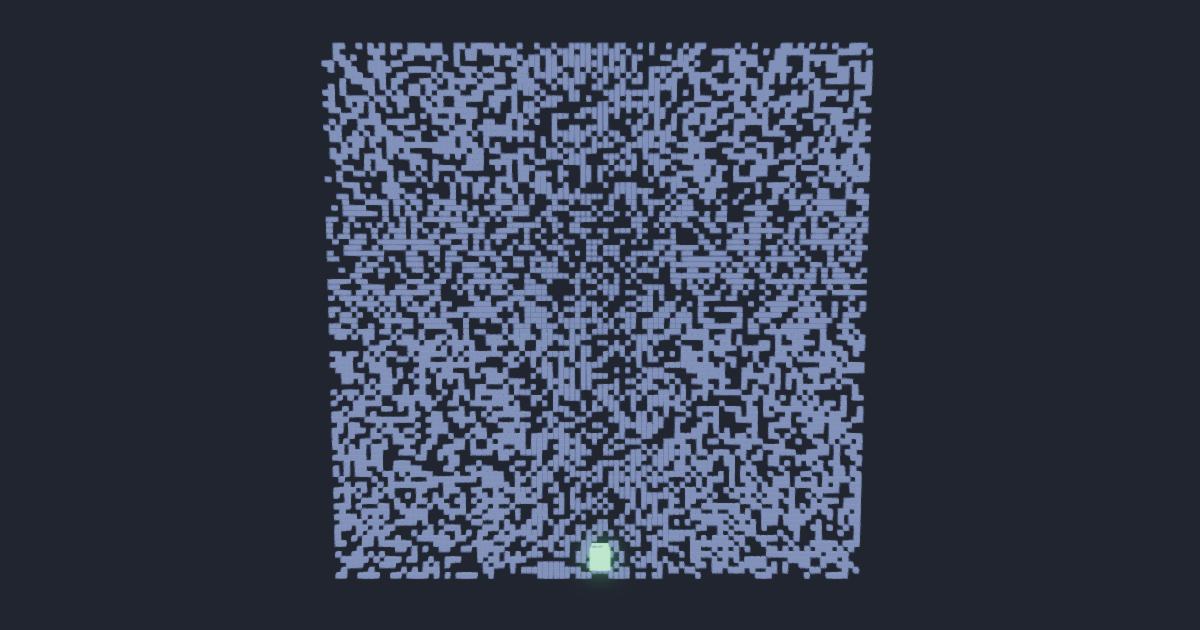
▶ Run the simulationSee the measured result
Units: dimensionless occupation probability (square-lattice site-percolation threshold; no closed form — Jacobsen 2015 graph-polynomial value 0.59274605079210(2))
Occupy each site of a square lattice independently with probability p; find connected clusters with union-find. Sweep p and, over many random lattices at each value, measure the spanning probability Π(p) (a cluster reaching top↔bottom) and the largest-cluster fraction (the order parameter); locate p_c at the Π = ½ crossing.
a connectivity phase transition at the known site-percolation threshold p_c ≈ 0.5927 for the square lattice — below it only finite islands, above it a lattice-spanning 'infinite' cluster
A threshold you cannot write down, on a page of thresholds you can. Square-lattice site percolation is the textbook critical point — occupy each site independently with probability p and somewhere near 0.5927 the lattice snaps from islands to edge-to-edge connectivity — and it is also the one number here that has no closed form at all. It is known to fourteen figures from graph polynomials (Jacobsen 2015) and to zero figures from algebra, because the square site lattice is not self-dual and no star–triangle relation reaches it. So the first direction on this page does not evaluate a formula: it does what this world's oracle does, taking two finite lattices and removing the leading finite-size term, p̄(L) = p_c + a·L^(−1/ν) extrapolated to x = 0. The exponent it extrapolates with is measured too, from how the transition WIDTH shrinks: σ(L) ∝ L^(−1/ν) is one division of logarithms, and that self-bootstrap is what keeps the recovery non-circular. The neighbouring lattices are where algebra wins, and they are listed precisely to show what this one is missing — triangular site and square bond are exactly ½, triangular bond is 2 sin(π/18) with the honeycomb as its dual (the page evaluates their sum and gets 1), a Bethe lattice of coordination z is 1/(z−1) because a loop-free graph turns percolation into a branching process, and a one-dimensional chain of N sites has mean spanning threshold exactly N/(N+1), escaping to 1 and never arriving. The exponents are the opposite case: in two dimensions every one of them is an exact rational, so β = 5/36, γ = 43/18, ν = 4/3, η = 5/24, δ = 91/5, d_f = 91/48 and τ = 187/91 are built here as integer divisions and the six relations between them — hyperscaling, Rushbrooke, Widom, Fisher, the fractal dimension and the cluster exponent — are evaluated rather than quoted, every residual landing on zero. That is the whole lesson of this world in one screen: the threshold moves with the geometry (0.5927 square, exactly ½ triangular) while the exponents do not move at all. Four things this page will not do. It will not correct a number the lab recovered. It will not invent a closed form for the square site threshold — there is not one, and manufacturing an expression that happened to land near 0.5927 is exactly what rung 7 forbids. It will not supply the non-universal amplitudes ξ₀ and the cluster-size prefactor, which are boxes here and set to 1. And unlike this lab's number-theory pages it cannot stay inside the correctly-rounded operations: a power with a non-integer exponent and a ratio of logarithms are on the critical path, so those figures stop at 9–12 significant digits and only the exponent identities are quoted at the ulp.
p̄(L) = p_c + a·L^(−1/ν) · σ(L) ∝ L^(−1/ν) ⇒ ν = ln(L₂/L₁)/ln(σ₁/σ₂) · ξ = ξ₀|p−p_c|^(−ν) · triangular site & square bond p_c = ½ · triangular bond p_c = 2 sin(π/18) · Bethe p_c = 1/(z−1) · chain ⟨p⟩ = N/(N+1) · β = 5/36, γ = 43/18, ν = 4/3, d_f = 91/48, τ = 187/91