Known value
0.03226
Make a chain of springs slightly nonlinear, put all the energy in one mode — does it spread out and thermalise (equipartition), as statistical mechanics assumes?
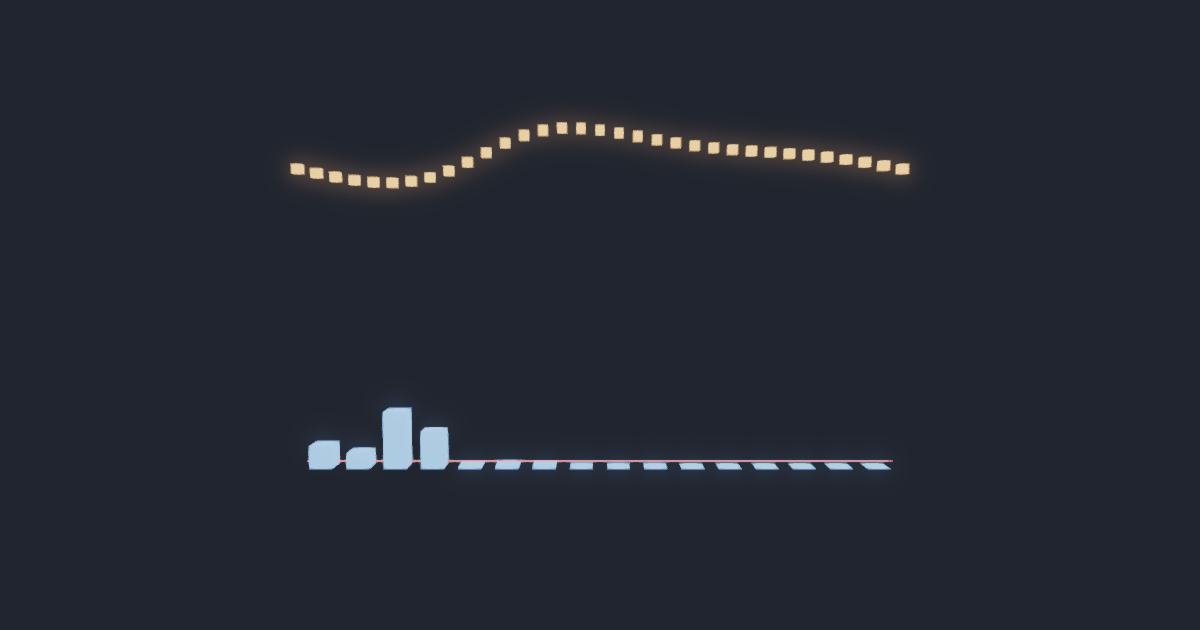
▶ Run the simulationSee the measured result
Units: dimensionless — the equipartition prediction for the mode-1 energy fraction, 1/(N−1) with N−1 = 31 modes; the value mode 1 would relax to IF the chain thermalised. This is the prediction the experiment FALSIFIES.
Integrate the FPUT-α chain ẍ_j = (x_{j+1}+x_{j−1}−2x_j) + α[(x_{j+1}−x_j)²−(x_j−x_{j−1})²] (N=32, α=0.25, fixed ends) with energy-conserving velocity Verlet, starting all the energy in mode 1. Project onto normal modes each step and watch the per-mode energy fractions E_k(t)/E_tot over ~two recurrence periods.
the FPUT recurrence (1955): energy does NOT equipartition. It flows into a handful of low modes — mode 1 drains to ~6% — and then almost entirely RETURNS to mode 1 (~98%), the chain nearly retracing its initial state, periodically. The energy never reaches the equipartition line E_tot/N_modes. This non-thermalisation in a nonlinear system seeded soliton theory, KAM, and the modern study of integrability — the surprise that the obvious assumption of statistical mechanics simply failed.
All the energy in one mode of a slightly nonlinear chain, and the question of whether it ever comes back. Statistical mechanics says it should not: a generic nonlinearity is supposed to share the energy out until every mode holds 1/(N−1) of it. In 1955 Fermi, Pasta, Ulam and Tsingou put all of it in mode 1 of a 32-site chain, watched it drain — and watched it return. Nothing this world measured is stored on this page. Every frequency is assembled from the chain's own eigenvalue problem, ω_k = 2·sin(kπ/2N) being what the fixed-end difference operator returns; the starting energy from the identity Σ_j sin²(jπ/N) = N/2; the effective mode number from Shannon's entropy of a model spectrum. The lab's eight readings are carried for SCORING only — zero every one of them and not a single computed number moves. Three results here are not restatements of the finding above. Equipartition is not merely 'falsified': the measured 0.978 return stands 525.4 seed-σ, and 2574.0 standard errors of the seed mean, above the 0.032258 it predicts. The chain starts with EXACTLY its linear mode-1 energy, because the cubic part of the potential contributes −1.6e-19 of it — the strains are antisymmetric about the midpoint and a cube preserves that antisymmetry — so the nonlinearity that will empty and refill the mode is worth nothing at all at the instant of release. And the 1% initial-condition noise the ensemble is perturbed with has a closed-form price: ½σ²Σω_k², with Σ_k ω_k² = 2(N−1) exactly, is 0.3353% of the total energy, against the 0.35% gap the finding discloses between its noiseless run and its perturbed mean and accounts for by direction alone. One box carries the rival: lat = 1 is the lattice a row of masses and springs actually has, lat = 0 the continuum string — and the string's spectrum is a perfect harmonic ladder, so it predicts nothing to dephase, nothing to drain, and nothing to recur. The neighbours are named rather than absorbed: the ring version of this dispersion, with the ω = 2 ceiling this chain never attains, is priced at ?world=phonons, and the soliton explanation of the recurrence is ?world=kdv's, not re-derived here. Four things this page will NOT do — predict the recurrence TIME, which this lab measured rather than derived; read a 31-mode spectrum out of one entropy number; do the β-model, a periodic ring or a disordered chain; and correct any number the finding recovered — are spelled out under the directions that would otherwise be tempted.
ω_k = 2·sin(kπ/2N) · T₁ = 2π/ω₁ ≈ 2N · p_eq = 1/(N−1) · n_eff = exp(−Σ p_k ln p_k) · E = ½ω₁²A²·N/2 with Σ_j sin²(jπ/N) = N/2 · ω_k/(kω₁) − 1 ≈ −(k²−1)(π/2N)²/6 · Σ_k ω_k² = 2(N−1) · string rival: ω_k = kπ/N