Measured by the lab
1.4142133
Why is gravity inverse-square? In a possible world where F = −μ/rᵖ, do orbits still close — or do they precess?
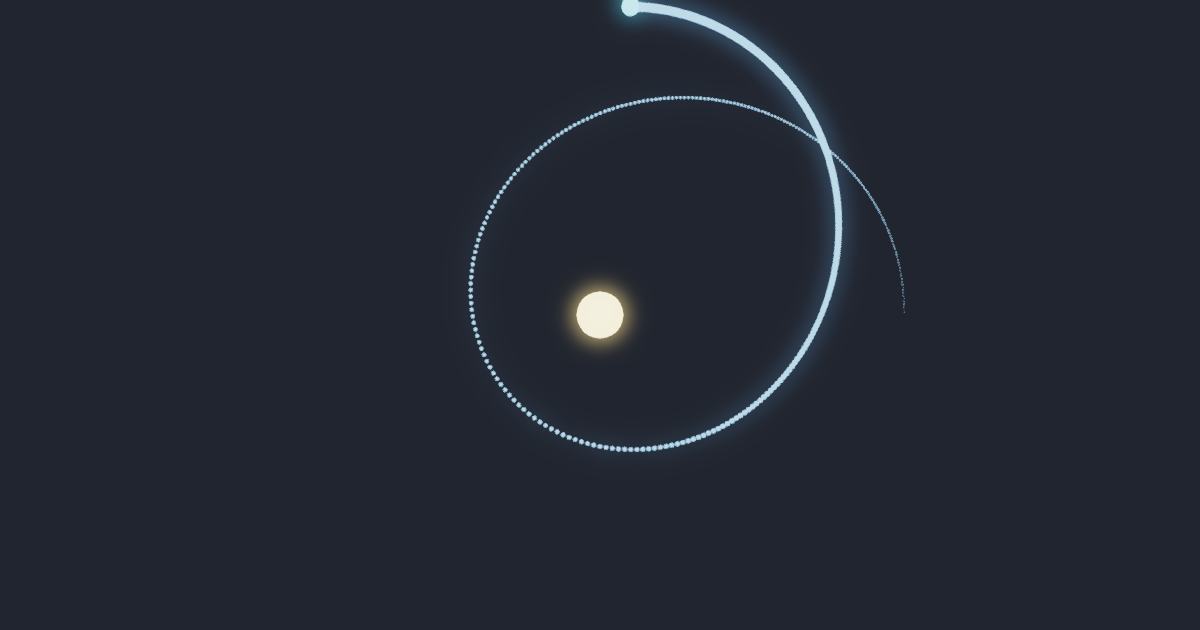
▶ Run the simulationSee the measured result
Units: dimensionless (Φ/π at p = 2.5 = 1/√(3−2.5) = √2 exactly; Φ = near-circular apsidal angle)
Make the force exponent p a knob and orbit a planet about a fixed star (symplectic leapfrog); measure the apsidal angle Φ (the angle swept between successive closest/farthest points) and compare it to the near-circular law Φ = π/√(3−p).
Bertrand's theorem: a bound orbit closes (Φ a rational multiple of π) for ALL initial conditions only at p = 2 (Kepler) and p = −1 (Hooke); every other exponent precesses into a rosette