Measured by the lab
6.325914
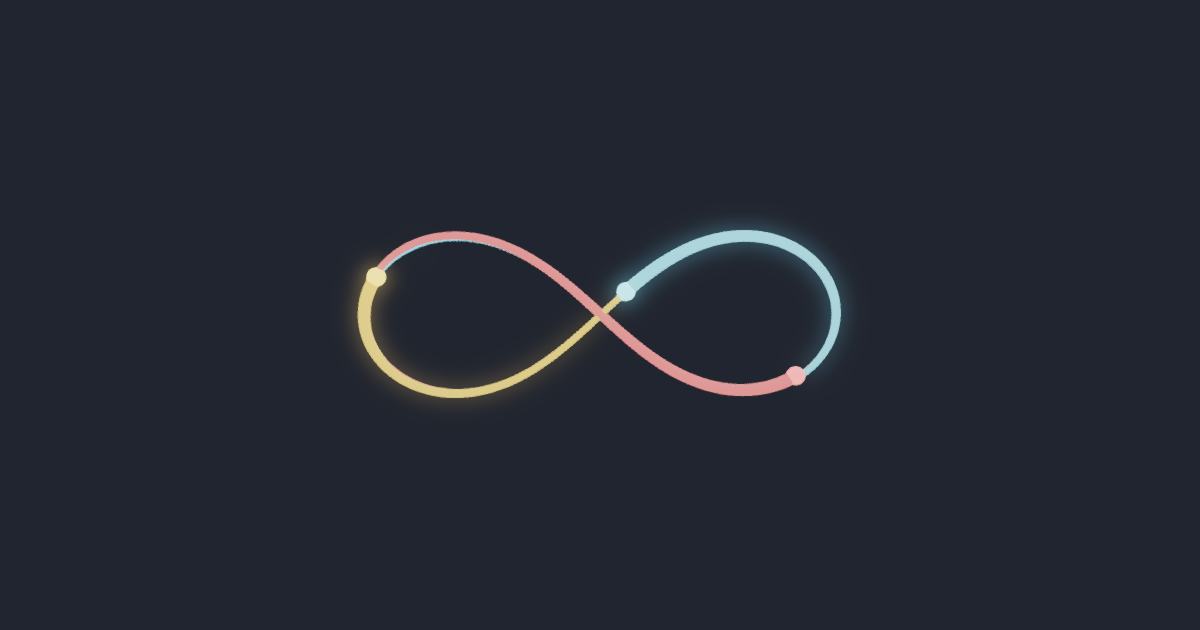
Is the three-body problem chaotic — and is the famous figure-8 choreography a stable exception?
▶ Run the simulationSee the measured result
Units: dimensionless time (G = m = 1, standard figure-8 normalization)
Evolve three equal masses under mutual gravity (symplectic velocity-Verlet) alongside a near-identical Benettin twin started δ₀=1e-8 away; track the phase-space separation, renormalise it, and average its log-growth into the largest Lyapunov exponent λ.
λ > 0 (exponential divergence of nearby trajectories ⇒ deterministic chaos) for a generic triple, vs λ ≈ 0 for the linearly-stable figure-8 choreography
How long a gravitating system takes to come back, from its size and its mass alone. Everything bound by 1/r² obeys the same law — rescale an orbit by L → s·L and v → v/√s and it maps onto itself with T → s^(3/2)·T (mechanical similarity, Landau–Lifshitz §10; Kepler's third law is the two-body case). Only the dimensionless prefactor T̂ tells the configurations apart: T̂ = 2π for a two-body circular orbit (then M is the TOTAL mass and L the separation — enter those and Earth's orbit comes back as 365.25 days), and T̂ = 6.32591398 for the Chenciner–Montgomery figure-8 above (then M is the mass of ONE of the three equal bodies and L is their initial distance from the centre of mass, which the standard ICs put at 1.0000000 length units). That 6.32591398 is not physics typed in here: the simulation recovers 6.3259139869 ± 4.7e-8 by blind phase-space recurrence from raw RK4 of pairwise gravity, and fits the 3/2 exponent to 1.500000000 ± 5e-10 across a 16× range in period. Three things this lab does NOT measure, so the calculator does not pretend to: G itself (CODATA 2018 6.67430e-11, though the Cavendish world here weighs it independently), the ellipse — Kepler III holds for eccentric orbits with L the semi-major axis, which is never tested above — and relativistic precession, which this Newtonian sim has no term for.
T = T̂·√(L³/GM) · T ∝ L^(3/2) · T̂ = 2π (two-body circle), 6.32591398 (figure-8)